Powered By Blogger

Tuesday, September 14, 2010

Happiness is a glass jaw....


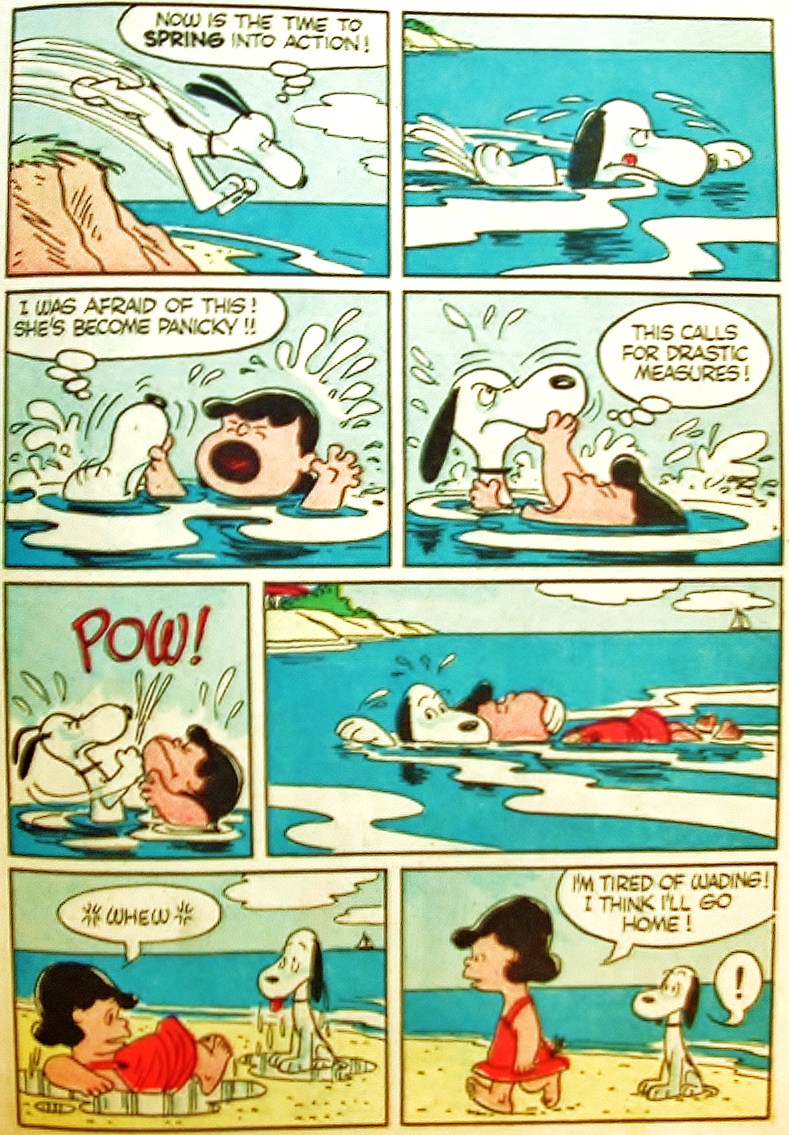
Snoopy punches Lucy
RECENTLY re-discovered in the humor archive of the Trivia Wing was this precious, precious image I think everyone who enjoys reading the Peanuts comic strip or watching the cartoons (or maybe only eating Zingers) will be ecstatic to see.

This one's a beauty! No digital manipulating was used to create this picture, and what you're looking at is an un-enhanced photo of said image.

Can you guess where it came from? (HINT: it's not from Mad magazine, a "Tijuana Bible" or The Onion.) Think about it....

Give up?

It's from the Peanuts comic book.

No, I didn't just "blow your mind"! Let me elaborate....

As the popularity of Peanuts gained momentum in the mid-1950's, Dell Publishing Company, makers of kid-friendly, "Comics Code"-approved comic books came calling to creator Charles Schulz and United Features Syndicate, his employer.

The majority of Dell's comics were licensed from properties as varied as Donald Duck, Little Lulu or The Lone Ranger; they also did an array of adaptations of movies and TV shows like Lassie, Leave It to Beaver or No Time for Sergeants (the movie with Andy Griffith). Now they wanted to take a try at Peanuts; an agreement was reached sometime after initial contact.

The first comic (dated 1953-54) was a "one-shot" containing reprints of the strip. A few other Dell comics series would also include reprints until Four Color Comics #878 (Feb '58 cover date), when what author David Michaelis (in his Schulz biography, Schulz and Peanuts) called "extended play" stories [with new stories and art] began. With Schulz's workload already burdened with doing two comic strips at the same time (the other being the short-lived It's Only a Game, a strip about sports that debuted in '57), the primary work would be handled by others, while he contributed new artwork for covers only.

The main person who wrote and drew stories for Dell was Jim Sasseville (born in 1927), a friend and colleague of Schulz's from the days when they both worked at Art Instruction, Inc. in Minneapolis. Sasseville had since become Schulz's assistant, and his main duty up until the Dell books came along was inking finished artwork and lettering for IOaG. Now, he'd be "ghosting" the comic books for $100 a week. After three Four Colors, the new material graduated to its own comic, the numbering starting at number 4 (Feb-March '60).

According to Michaelis, Sasseville was a very good artist in his
own right, and his greatest asset was a unique one; after Schulz, he was one of a select few who could draw Charlie Brown's round head. (It's not easy, as this amateur artist can testify!) Though the comic book which this picture came from is the first issue (May 1963) of the Gold Key run (Dell under a new name, actually), the material inside is copyright 1958, so it's reprints of a Dell book from '58. Based on the quality of some (not all) of the art (including some renderings of Charlie Brown's head), evidence suggests Sasseville's handiwork is in here.

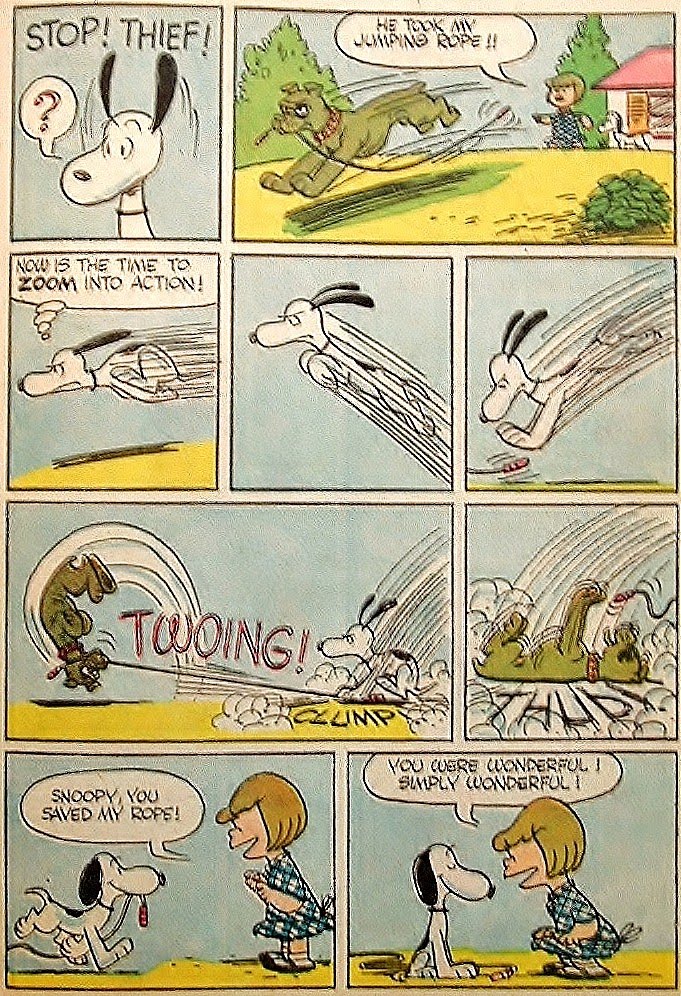
He might have done "The Hero", which is where this picture came from. The actual story (like all the stories in the book) is too long and lacks Schulz's humorous touches and comedic timing; the priceless illustration is the absolute highlight of the entire mess, it's so masterfully executed. Considering the "violent" content of the drawing (arguably, a touch stronger than what sometimes happened in the strip), I thought Dell would've objected to it and have the panel changed. Then again, it's a beagle belting a "fussbudget", so there's no harm or foul!

Check out the full story below! I decided on taking photos of the pages so their warped nature will simulate reading an actual well-worn comic! (NOTE: pages have been enhanced for an attempt at clarity; click on them for a better look.)

The last Dell was lucky number 13 (May-July '62). The last Gold Key was number 4 ( Feb '64), all of them reprints.

As for Jim Sasseville, Schulz eventually decided to devote all his energy to Peanuts, so he let Sasseville assume full control of IOaG; the strip ended a 63-week run in 1959. In 1960, he'd leave cartooning to be a graphic artist. He died on November 30, 2005, at the age of 78.





I think it's cool he got to work with Schulz in the capacity he did. (All written accounts I've read strongly maintain Charles Schulz never had help with the drawing and writing of the Peanuts comic strip, period!) Most of all, I'll always have a soft spot in my heart for the guy who drew what I consider the pen-and-ink equivalent of The Mona Lisa.

It's the best Peanuts drawing Schulz never did!

Keeping it trivial....

Fang Shih-yu, Shaolin Temple.

Tuesday, September 7, 2010

River of Fury (1973), starring Lily Ho, Danny Lee and Ku Feng. Directed by Chang Tseng-chai.

"Dad passed away over a month ago. I've paid up all the debts. I don't want to be like Dad, farming in the countryside. I'd rather go out and see the world like Duobo."

WITH this opening line (rewritten from the English subtitles for clarity), so starts River of Fury, a drama from Shaw Brothers that features the first leading role of prolific actor/producer/director Li Hsiu Hsien, better known to many people as Danny Lee (Super Inframan, The Mighty Peking Man).

Here, he is Zhou Yezhuang; his friends call him Yezhuangzi (Mandarin for "strong country lad"). After his father's death, the son of a farmer sells the property, deciding to venture into the outside world to earn a living while having a little adventure (maybe) along the way.

He looks up a friend of his father's, Duobo (Ku Feng, The Avenging Eagle), a helmsman for a boat that carries Wang's Opera Troupe, a group of actors who travel town to town performing Chinese operas for people from the countryside. The touring company has just arrived in Yezhaungzi's hometown to do some shows.

Getting past the bad news of his friend's death, Duobo is more than happy to have Yezhuangzi aboard and help him out, saying, "I'll count you in no matter what business I have." In this case, on dry land, Duobo's business is opium smuggling. More on that later.

In the meantime, Yezhuangzi has fallen for the lead actress in the troupe, Ge Yiqing (Lily Ho, The 14 Amazons), their feelings firmly established as mutual when Yezhuangzi rescues some underwear of Yiqing's from the river after it accidentally falls in while being laundered.

When the boat comes to the next town, Duobo takes Yezhuangzi along on one of his excursions, and the young man finds out about Duobo's smuggling (the primo merchandise kept hidden in a wine jar on the boat). Duobo says it's easy money, compared to what he gets for running the boat, and he doesn't want to spend the rest of his life steering a boat. Yezhuangzi goes along with the notion with some reservations, feeling some of the itch Duobo has for the easy money.

Later, sometime after Yezhaungzi and Duobo save Yiqing from a spurned playboy (Fan Mei Sheng, The Water Margin) during a performance, Yezhuangzi declares he wants to marry Yiqing, buy some land, and settle down with her. With Duobo and Master Wang (Yeung Chi Hing, Vengeance!) along as support, he goes to see her mother (Ou Yang Sha Fei, Whose Baby is in the Classroom?). She doesn't think much of the poor farmboy, preferring her daughter should either be acting in bigger theaters for more money or marry into big money. When Duobo offers that Yezhuangzi will give a betrothal gift of $3,000 [HK] to her, she's as pleased as Yezhuangzi is shocked. How will he pay back Duobo?

In part, he'll go on a smuggling run for him, that's how. Duobo sends him off on a trip with the jar full of opium (giving him a gun for safety) while the actors have a two-month booking at a big theater in Shenjia Beach. Yezhuangzi will earn $500 [HK] for the task.

In his absence, a wealthy townsman named Liu (Tien Ching, Delightful Forest) sees Yiqing perform, and he's immediately attracted to her. So much so that he offers Master Wang even bigger theaters for the group to work in, sweetening the deal by agreeing to absorb the loss Wang will endure when the troupe breaks the 2-month contract. Wang accepts, and Yiqing becomes a star, becoming more popular than she's ever been. Most importantly, Liu quickly becomes engaged to Yiqing, much to her mother's delight.

Inevitably, Yezhuangzi returns weeks later to find his whole world turned upside down; of course, Yiqing will have nothing to do with him, but the real twist of the knife is when Yiqing's mother smugly gives him back the betrothal money. Duobo tries to help Yezhuangzi drown his sorrows by taking him to a brothel and getting him a prostitute.

Then, an associate of Duobo's suddenly arrives at the brothel, warning him the police apparently tailed Yezhuangi, finding two telltale ferry tickets in with his clothes, as well as the opium stash, on the boat, and they'll be arriving there shortly to arrest him. Duobo decides to let Yezhuangzi be the scapegoat rather than face justice himself. Yezhuangzi (who doesn't get it on with the prostitute, his heartbreak for Yiqing still strong) is taken into custody without incident.

After serving a two-year sentence, Yezhuangzi is released from jail, and with freedom comes a ride to Duobo's large mansion first thing (that's how big Duobo's opium business got while he was away). Also there waiting for him is Yiqing; she dumped Liu a while back (he wouldn't leave his wife for her), and with her mother now dead, she's free to get back together with him.

Yezhuangzi wants nothing to do with either of them, Duobo in particular, especially once he found out (while in the stir) how he was set up as a patsy. Duobo offers no true apology in return, and when he then has the utter nerve to ask Yezhuangzi to rejoin him in the business, it seems like a last confrontation between the two former friends is about to go down very soon.

After that . . . NO "SPOILERS"!

With a screenplay by Ni Kuang that's taken from a novel by Hsu Lu, RoF is a short (80 minutes) but solid drama with well-placed dashes of of martial arts and exploitation that aren't overdone. (The story actually takes place in contemporary times; I didn't really pick up on this until the scene when photographers in suits with 35mm cameras arrive at one of Liu's theaters to snap pictures of Yiqing.)

The direction from Chang Tseng-chai (The Casino, Sex for Sale) is smooth and assured; he gets high-caliber acting from all the actors under his guidance. He makes the movie look like an "A" picture thanks to excellent photography, the music score (stock cues, most likely) adding to the atmosphere of the proceedings.

Danny Lee takes the familiar country bumpkin stereotypical role of Yezhuangzi and gives it some dimensionality; his earlier scenes with Lily Ho are charming, with flashes of bashfulness that I didn't expect at all. He handles all scenes with such a naturalness that it makes me wonder why he didn't move on to another studio sooner to do bigger-budgeted pictures more worthy of his talent.

Nothing's wrong with Lily Ho's work in this; she's fine (and foxy) as Yiqing. She has great chemistry with Danny Lee, and the highs and lows of the relationship are comparably carried well by her. Her Chinese opera scenes are a special treat, considering she had previous experience performing in actual ones.

The ultimate Shaw actor, Ku Feng, does an extraordinary job of making Duobo seem to be an otherwise upright person who turned drug smuggler to help make ends meet; he is practically a mentor to the farmer's son, so when he lets Yezhuangzi take the bum rap (mere minutes after getting the kid a hooker!), this predictable turn is given a special texture through Ku Feng's nuanced acting.

The rest of the cast provide equally strong support to the leads, including [the recently deceased] Ou Yang Sha Fei in her finely-tuned portrayal of a stage mother. (Some will debate it, but I'll contend she's the real villain in this story.)

Though RoF is only a drama, there are a couple of martial arts scenes included here; they're choreographed by Yuen Woo-ping and Yeun Cheung Yan. Danny Lee and Ku Feng do the work very capably, both of them showing a lot of athleticism that's all the more astounding when you see everything Ku Feng does.

As always, IVL's DVD has the nice anamorphic Shawscope picture, good audio (in Mandarin), passable English subs and the typical special features.

The brevity of the film doesn't hamper what is a well-told story that exhibits no signs of being padded out. The drama was riveting enough that I did not find myself constantly watching the time or twiddling my thumbs while waiting for the fighting! Fans of Shaw martial arts films who've considered buying any of the other genre movies they did won't go wrong if they start with this one.

Highly recommended by Brother Fang!

Keeping it trivial....

Fang Shih-yu, Shaolin Temple.

P.S. - Purchase it from Play-Asia by clicking on here.

Saturday, September 4, 2010

Revisions: They drive me "Charlie Brown"!

I forgot to add a COMMA?!
EVERYONE strives to improve themselves in some sort of a way. The people who do this without putting much thought into it? They're the lucky ones.

Then, there's Brother Fang!

I have no problem dealing with correcting factual errors or inserting additional information on a post to the degree of a significant rewrite, especially if it helps to give a point I have more substance to it. (If you've looked at my Heroes Two entry more than once over a span of time, then you may have experienced this already.) What gets at my insides is writing itself.

I'm fortunate now to be able to make paragraphs on a computer (and annoyed at how simple it was to do that I didn't figure it out sooner), but I'm still dealing with the spelling, grammar and literary flow of the English language, and the proper punctuation of same!

I know this is "only a blog", and in this particular media, little lapses of any fashion are the norm, but I often try to express myself beyond my current boundaries, so writing is an exercise I work at. It's mental aerobics, and I'm getting my brain back into condition. You're ringside observers to the process with each posting I publish, so I thank you all for being patient readers, no matter how many times I tinker with my writings. (Even Roger Ebert makes errors, recently writing on his blog that Jodie Foster appeared in The Parent Trap! He meant Freaky Friday, and he corrected himself within hours of the posting on Facebook.)

At times, my revisions do feel like a "Charle Brown" (a.k.a. "AAUGH!") moment, like the times he struggled with a pen while writing a pen pal, lost ballgames, or never summoned up enough nerve to talk to the "Little Red-haired Girl". Like Chuck, a lot of my frustrations are all in my head, so I need to get past my anxieties.

Having recently journeyed from Pennsylvania to Indiana (as of yesterday), I'm feeling positive the new locale may be beneficial for my relating to everybody more items from the wonderful place that is the Trivia Wing. If all goes right, I'll have fewer and fewer "Charlie Brown" moments!

Here's hoping.

Keeping it trivial....

Fang Shih-yu, Shaolin Temple.

Friday, August 27, 2010

Forgotten Fun: "Judge GTO Breakaway" (1969), recorded by Paul Revere & The Raiders

FOR Brother Fang, a highlight of the Collectors' Choice Music reissue I got a week ago, Paul Revere & The Raiders Featuring Mark Lindsay: The Complete Columbia Singles (3-CD set), is the rare promotional side of "Judge GTO Breakaway". The record was used as a marketing gimmick, the lucky buyer of one of these muscle cars from the Pontiac division of General Motors receiving a new vinyl 45rpm single for FREE as an additional reward for choosing such a sweet ride!

Original print ad for The Judge. (Click on image for better view.)
Written by Raiders Mark Lindsay and Keith Allison, the song is adapted from the earlier Raiders tune "Time After Time" (found on their Hard 'N' Heavy LP), and the final result does what it's supposed to: sell the car in as few words as possible. (Not by Twitter standards, praise the gods!) Of course, this was the case with all the car songs that got recorded in the '60s (promo or not), but by '69 (when this was released, exclusively given away by Pontiac dealers), the sound evolved beyond that of the "surf music" sound of "G.T.O.", "Three Window Coupe" or "Corvair Baby" (the latter another, earlier Raiders promo).

The mono recording (consisting of Lindsay on lead vocals, Allison doing all the guitar parts and Raider Joe Correro, Jr. on drums) is a groovy, fuzz-guitar-drizzled, pedal-to-the-floor romp that has as much attitude and horsepower in its 2:48 running time as one of the actual cars! For a song that's a well-produced "throwaway" (with a slick, shortened edit of the "TAT" backing track), it can't help but be imbedded in my mind after hearing it all the times I have -- several times!

Don't make me tell you how many!!

As for the vehicle itself, The Judge was a deluxe edition of the GTO that came out for the '69 model year (so they were available in the latter part of '68), the name deriving from a recurring comedy bit on the then-popular TV show Rowan & Martin's Laugh-In, where guest Sammy Davis, Jr. did his version of comedian Dewey "Pigmeat" Markham's old "Here Come De Judge" burlesque routine. (Markham owned the rights to his "Judge" song, and since GM didn't want to pay the $250,000 for using it in advertising, they opted for a cheaper alternative.)

These particular GTOs weren't around forever, and the rest of all muscle cars would soon follow suit, their popularity crushed by the '70s energy crisis. Today, wherever these materialize at auto shows (reportedly, not too often), a preserved or restored Judge is an impressive thing to see, parked or running! They're a nice dash of nostalgia.

The same can be said of Collectors' Choice Music Singles set, all 66 "A" and "B" Columbia sides (including those rare promos) by the Raiders in their original mono or stereo mixes, digitally remastered by Bob Irwin with dynamic sonics. The CD booklet's liner notes, written by Ed Osborne, are also well executed, featuring interviews with Lindsay and Paul Revere; it offers a brief but wide-ranging summary of the ups and downs of the Raiders' Columbia era. If you're wanting something more other than a single-disc "Greatest Hits" compilation, as well as getting a chance to listen to the hits (and "misses") with a sound quality surpassing that of the best "mint" condition 45s on the most expensive of turntables, this collection is for YOU.

In closing, savor The Judge and Paul Revere & The Raiders by clicking on here.

The commercial was shot at a location in the Mohave Desert called El Mirage Dry Lake.

Keeping it trivial....

Fang Shih-yu, Shaolin Temple.

Tuesday, August 24, 2010

Farewell, My Love (1969), starring Julie Yeh Feng and Kwan Shan. Directed by Chin Chien.

BOY, little did I know the second I started indulging myself in those import Shaw Brothers DVDs (from IVL) that went beyond the familiar territories of wuxia or martial arts what a rollercoaster ride they'd be. (I credit one "Glenn" over on A Pessimist is Never Disappointed with my excursions.) I've only seven of these kinds of titles, so far, but the sampling of dramas, comedies and musicals I've invested in has been an indoctrination to another reality of sorts! If you know what to expect with a Shaw movie containing swordplay or hand-to-hand combat, be prepared for a jolt with a Shaw "tearjerker", if you dare to take the plunge; you're not in Hollywood anymore!

In the case of Farewell, My Love, we have a drama with an issue which still holds relevance today: cancer. It's the reason why Jiang Han (Julie Yeh Feng) cannot conceive another child. (The cancer is only characterized as "inoperable", but maybe it's ovarian cancer?) From her diagnosis onward, it becomes anything but a Lifetime movie.

How does she decide to deal with her ailment? By courageously...letting it run its course, not telling any of her friends or family in the process!! That's right; she won't even go for a second opinion, and even the slightest possibility that something can be done to save her doesn't give her inspiration to fight it.

She accepts the fact (and a prescription for pain pills) she's only months to live; in the time remaining, she must find a woman to take her place as a wife to her architect spouse, Shimin (Kwan Shan, Police Story 2), and as a mom to her daughter, Lingling (Niu Niu, The Brave Archer 2).

As luck would have it, her husband recently hired an assistant, a pretty young lady with some emotional baggage of her own, Chuchu (Jenny Hu, Love Without End); she performs well at her job, but no one knows why she keeps a distance from the male co-workers who are attracted to her. Shimin thinks she's a touch strange; even so, Jiang Han quickly befriends her, not only inviting her to Shimin's birthday party, but also finding out why she is as morose as she is.

Chuchu's a widow; after a rough childhood, her husband was the only one who truly gave her love and affection, and his fatal car crash has left her isolated and lonely. With the passage of time, Chuchu practically becomes part of the family, even showing a fondness for Lingling to the point of giving her piano lessons. It doesn't take much longer before Jiang Han thinks Chuchu may be the suitable replacement for her. In fact, she's soon told by Chuchu that she's going to quit her job because she's fallen in love with Shimin!

Realizing her odd turn of good fortune, Jiang Han manages to stop her from quitting and keeps her around as a family friend; perfect timing, as it turns out, with the cancer beginning to drain out the life that's left in her. Shimin finally learns about Jiang Han's condition shortly before they go off on a trip to celebrate their tenth wedding anniversary; they eventually depart, letting Chuchu stay at the house to care for Lingling, Shimin not knowing if he will return with Jiang Han alive.

After that, I do not think I need to tell you how it ends; you may be right about the basics, but the way things exactly finish up would catch you unawares!

NO "SPOILERS"!

Farewell, My Love would rate more highly to me had I not previously seen an earlier Shaw release, Susanna (1967, directed by Ho Meng-hua), prior to this; I'm glad I did, because its quality shows how much FML is but a half-baked rip-off, despite good performances.

In Susanna, the teenaged title character (Li Ching, King Eagle) has a terminal brain cancer; like in FML, she tells no one until her time is nearly up, all the while trying to tie up as many loose ends in her life before she passes on. The movie even has in the cast actors who later turn up in FML: Kwan Shan, Niu Niu and Fang Mien (King Boxer), who plays a doctor in both films!

The big difference between the two movies is the script for Susanna is more cohesive and less riddled with holes than the one concocted for FML, where plot lines are only carried so far only to just move the story along with no tidy conclusions brought to any of them.

While fighting cancer in 1969 was a real uphill battle on many fronts, compared to now, I still could not believe Jiang Han giving up so easily; considering her spouse was a well-paid architect, and the family lived in a mansion with servants, I know Shimin had enough money (and health insurance) that an attempt to save his wife (or prolong her living, if only for weeks or months) could be done. (Susanna, with her brain cancer, had an arguably lesser chance for survival. Whether she had told her family or not about it, I believed her to be terminal, so her story's more plausible than anything in FML.)

Mainly, the purpose for this movie's existence was to showcase the talents of Julie Yeh Feng, a Hong Kong actress whose twelve-year run in films was ending in an early retirement. She had previously spent half of that time with the Cathay Organisation (Our Sister Hedy, 1957; Air Hostess, 1959) before finishing with Shaw. (Her 1964 Shaw debut,The Warlord and the Actress, was scripted by Chang Cheh.) She's a long way past the time when International Screen Magazine once referred to her as the "Kim Novak of the East", but once you get by the '60s hair and fashions in this (older pin-up shots of her, found on the Soft Film blog, are eye-popping), she's still quite attractive and does a fine job of acting, script be damned.

Jenny Hu comes off as an Audrey Hepburn type with a low-key performance that gradually blossoms as Chuchu comes out of her shell. Really, all the cast does work superior to the uninspired script they were given. (Any fans of the Shaw martial arts films will want to watch for Chuan Yuan, who'd go on to do movies like The Lady Hermit, Vengeance! and The Thunderbolt Fist, in an early role as this movie's only [lame] comedy relief.)

The IVL DVD is another nice example of Celestial Pictures' restoration efforts with a clean, anamorphic picture, very good sound and decent English subs; this cannot be disputed!

Unless you're a Julie Yeh Feng fan who wants all of her movies currently available on DVD, there's no good reason for anyone else to get FML; the other performers featured here were in films better than this, and you should try seeking out (and spending your money on) those ones, including Susanna!

Keeping it trivial....

Fang Shih-yu, Shaolin Temple.

P.S. - Purchase it from Play-Asia by clicking on here.

Tuesday, August 17, 2010

The Big Con: "TV on DVD"

I tell you, reissuing TV shows on DVD (or Blu-ray) may have been something the entertainment industry should've never started doing in the first place. There's nothing snobbish about my opinion, as I've a few of these sets in my collection; the problem I have with them --across the board-- is addressed by the photo of this collection of Gomer Pyle - USMC. What catches the eye on this cover, above all else? The word "COMPLETE". Whether a notation like this is on a set's packaging or not, the concept is implied as being there by the companies putting these out due to the DVD format.

Compared to those by-gone days when some of TV's classics got released on VHS tapes in big, bulky sets (mostly with little to no "extras"), the point that these discs were smaller in size, more flexible with holding video and audio than tape (opening it up for all kinds of "special features"), yet still play back with a sharp picture and sound, meant DVD sets could hold more while taking up less space on media shelves. Yes, DVDs trump VHS tapes, but the newer technology doesn't automatically guarantee "COMPLETE"; neither do the DVD makers, as it turns out.

Regardless if you've looked at these box sets in a discount store or online, it probably hasn't been taken long before you notice that the more recent the TV program (broadcast, syndicated or cable), the more complete it will be. (Two examples are NCIS and Friends.) On the other hand, the more you go back in time through the history of television, the more older sets will be less complete. On either end of the spectrum, consumers can be spoiled by the most ambitious of collections (whether they buy them or not); after newer ones, older sets like those for I Love Lucy or Adventures of Superman were lovingly assembled with uncut episodes and an array of extras that make other sets look anemic. (The Lucy sets really raised the bar in this department.) In-between these old and new "deluxe editions", what is there? Where to start?!

Let's begin by establishing this: above all else, what a DVD set of TV shows should contain is complete, uncut episodes, no matter how long it runs/ran; anything more is much overkill! This comes from someone who LOVES "extras", so Brother Fang is amazed he said it as much as the reader may be!

With that established, several sets fall short on this aspect alone for many reasons. Going back to the example of Gomer, once I started reading consumer feedback about all the box sets on Amazon, I was floored by what I read. As the first season set was deemed by purchasers to be COMPLETE, the rest of them weren't. (The other sets of seasons do NOT use "COMPLETE" anywhere in the copy printed on the insert sleeves.) What's missing from these other sets is a selection of songs sung by Jim Nabors, cut due to licensing hassles; how many, I can't recall. On top of this, the same cut shows in dispute run in syndication with the songs intact! (Sure, I can live without his singing, but several fans of Nabors are ticked off by the removal of the songs.) That those at Viacom (by way of CBS Video) would go all out to release complete runs of I Love Lucy, Star Trek and The Andy Griffith Show, then drop the ball on the hit Griffith "spin-off" (ranking as high as number two in the Neilsens in its heyday) is confusing; how bad are those licensing fees that they decided to edit episodes rather than pay off some music publishers? (Thank goodness they didn't sing "Happy Birthday" on all the shows!)

This is the same company who went through the hassle of putting out the first season of Love, American Style (on two sets, the shows presented in their original "hour" lengths), a show many find less essential than the worst Gomer episodes, and it never attained the ratings Gomer did, besides! Then, they dust off "second-tier" programs like The Lucy Show or Petticoat Junction and give them great starts while the long-running My Three Sons has its incidental music score ripped out of what shows have been released so far (replaced with synthesizer music) because of (again) licensing! (The last three noted shows are not completely out on DVD as of this date.) Needless to say, this is but a sampling of many inconsistencies going on at just ONE organization; there are others who contribute to the dilemma.

Space limits a listing of every flawed TV box set, but I can bring up some more examples. For every show that loses some of its music due to licensing (WKRP in Cincinnati has suffered the worst in its initial DVD reissue), there are those sets that contain "syndication prints"; these versions of episodes are all missing minutes of footage [to varying degrees] because of the need to accomodate the extra time for commercials that became the norm on TV since the '70s. All hit shows that have been syndicated over the years got/get trimmed, but for all those programs where complete shows were/are saved in storage for future use in some way (mainly, home video), others got trimmed but their original sources got misplaced or destroyed, leaving only the shorter versions left. While some workers on these collections have gone the extra mile of taking time to complete what shows they can by locating the missing footage from other films (or tapes) and combining them with the syndicated version into a composite edit (yielding a complete episode), some companies disregard trying to please potential consumers and release the chopped-up versions as is; sometimes, they mention this (in fine print) on the cases, or they don't. Oblivious buyers find out the hard way, by putting down their hard-earned money for these sets (like ones for The Real McCoys, ALF or Mama's Family), only to find out they've been had after playing the first disc! (Sometimes "extras" are used to try to make up for these shortcomings.)

If any of the episodes of a given season of whatever TV show in a set cannot be complete in length, the DVD producer should either say so in big letters on the set's case or NOT put out a set at all! It all comes back to what the buyer wants these collections to be the most: "COMPLETE"!

After licensing and source material, other problems would relate to the packaging (cardboard cases and discs in sleeves aren't the best ideas, no matter how they're used in a great design scheme), technical aspects (worst of these, the "flipper" discs that contain stuff on both sides, which are alleged to be less durable than regular DVDs), etc. The mess goes on without any end in sight.

Until all entertainment companies (including smaller reissue labels who license shows from the big guys) treat all TV shows (new or old) equally via the almighty Digital Video Disc, don't expect me to patronize the syndicated reruns of any program on the air now; they are nothing more than "carrots" being proverbially waved in my face to entice me to buy the crap they want me to buy, NOT the stuff Brother Fang actually desires! It's never too late for a company like Viacom to do the right thing; I've got the rest of my life to wait!

Keeping it trivial....

Fang Shih-yu, Shaolin Temple.

Friday, August 13, 2010

Heroes Two (1974; Blu-ray edition), starring Fu Sheng and Chen Kuan-tai. Directed by Chang Cheh.

SORRY about the delay for the second entry; I had so many ideas as to what this installment had to be, I got myself in a bit of a pickle, deciding which one to use next. Luckily, this reissue popped up on Tuesday from the fine people at Media Blasters (under their Tokyo Shock imprint), only a week past the second announced release date for this Blu-ray version of a popular film from the unique movie sub-genre that is Hong Kong action cinema. Considering how the end product turned out, any delays MB had taken in doing this movie proper turns out to be justified!

In terms of "old school" martial arts movies, many have seen Heroes Two (1974), the first of director Chang Cheh's "Shaolin cycle" of movies, less as a classic and more as a "quickie" mainly because how fast it was put together. (It was being filmed concurrently with what would be the sequel, Men from the Monastery, also 1974.) Cheh had his own film production company in Taiwan set up at the time, and he was under pressure from Shaw Brothers to make hit movies for them at a fraction of the cost of an epic like his own The Water Margin (1972; co-directed with Wu Ma and Pao Hsueh-li).

Possibly due to fight choreographer Lau Kar Leung's proficiency in the "Hung Fist" martial art, Cheh picked up on some old Chinese history and the account of how a student of the Shaolin Temple, Hung Hsi-kwan, wound up developing his namesake martial art that is still practiced today. (Or was Cheh inspired by The Prodigal Boxer, an independent release from '73, which is an earlier telling of the story of Fang Shih-yu, played by Meng Fei? The film is full of Shaw regulars and features as an action director Lau Kar Wing, younger brother of LKL.) Cheh covered the stories of Hung and fellow Shaolin heroes (like Fang and Hu Hui-chien) in four of the eight movies he would make in this series. (The other three were new stories with new characters, and people like Hung would only be mentioned by name.) After Cheh and his co-scripter Ni Kuang, the three constants in these films were the usage of authentic martial arts styles (primarily Hung fist, of course, but even this was stylized for the movies) and actors Fu Sheng and Chi Kuan-chi (Kuan-chi's only a background player in HT, however). While not an epic in scale and its execution, it still contains an epic's worth of fun, thrills and "heroic bloodshed".

HT begins with a wounded Hung Hsi-kwan (Chen Kuan-tai) killing Manchus as he escapes from the burning down of the Shaolin Temple; the Manchus, led by General Che (Chu Mu), begin to hunt him down in hopes of finding out where more Shaolin escapees may be.

As sure as Hung's outfit is black, we soon see another Shaolin fugitive clad in white, Fang Shih-yu (Fu Sheng), who gives off a strong air of righteousness that borders on arrogance in his capacity of being a hero. (The moment anyone finds out his name, they readily know who they're dealing with, such is his reputation.) More importantly, despite both being from the temple, Fang and Hung have yet to meet. (It's conveyed Hung was in and out of the temple often, compared to Fang.)

Because of this, the Manchus easily convince Fang that Hung is a thief and murderer they're trying to catch; not long afterward, he unwittingly helps them to nab him.

With Hung taken to a nearby town and imprisoned in the basement of a Manchu sympathizer, word spreads of Fang's deed as he arrives in the same locale to see Li Shih-chung (Wu Chi-ching), a friend and Shaolin sympathizer who has a number of refugees staying at his residence. After a skirmish with the guys over the misunderstanding, Fang realizes the big mistake he has made; upon finding out about Hung's location in town, he attempts to free Hung, and he fails, barely escaping the Manchus after enduring two nasty blows from General Che.

After a quick recovery, Fang (starting from the Shaolin "safehouse") manages to dig a tunnel to Hung in just over a week's time (!) and frees him. Che and his men investigate the escape, eventually finding Hung, Fang and the other Shaolin fugitives waiting for them on a steep hill outside of town, ready to take out the Manchus permanently in a final showdown. Che (in his position as the head creep) comes prepared, surrounding the rebels with extra forces and bringing along a few "old friends" (some monks who practice Tibetan martial arts like the general does) to help eradicate the troublemakers quickly. Or do they?

NO "SPOILERS"!

After using The Deadly Duo as a "test run" for BD production, Tokyo Shock pulls off true HD versions (yes, 1080p) of HT and the Three Styles of Hung Fist featurette in fine fashion. If you thought the TS DVD looked great, be prepared to be further wowed with the BD.

Minor flaws inherent in the source materials aside (TSoHF is in better condition than HT), the Blu-ray format breathes new life into these films; it helps emphasize even the smallest of details, ranging from a stronger clarity to the all the sweating the actors did during filming (indoors and out) to facial expressions! (The late Fu Sheng's acting benefits most from the process.)

Audio options are the same as found on the DVD (notably, the commentary track by the late Linn Haynes is given a credit on the packaging); the English subtitles are still yellow, but they're now of a different, smaller font that doesn't block the screen like the subs on the DVD. (The translation is unchanged from the DVD, too.)

As for the special features, the majority of the ones from the DVD make it to the BD, and TS throws in additional ones for the people who've decided to trade up to the more "expensive" model! Most notable of them all are the Celestial Pictures edit of TSoHF (with language options) and the original Chinese opening titles to HT, including the logo for Cheh's film company (yes, it's Chi Kuan-chi pulling back that bow)!

Unfortunately, the English trailer (un-remastered with German subs) and that first Chinese version of the opening are non-anamorphic, which was somewhat a disappointment for me, but I think anybody can live with this arrangement as what most of us want is the short and the feature in HD. Even so, I know I can't be the only who'd love it if TS had built in a playback option where the original Chinese opening (made anamorphic) could be combined with the remastered film for the best approximation of the HK movie-going experience back in 1974. (You'll need to adjust the screen on your LCD TV in order to look at the English trailer in a non-distorted way.)

A must-have for all fans of Fu Sheng, Chang Cheh and "old school" martial arts movies!

Keeping it trivial....

Fang Shih-yu, Shaolin Temple.

P.S. - Purchase it from Amazon by clicking on here: Heroes Two (Blu-ray)