Powered By Blogger
Showing posts with label Chen Kuan-tai. Show all posts

Thursday, March 24, 2011

Four Riders (1972), starring David Chiang, Ti Lung, Chen Kuan-tai and Wong Chung. Directed by Chang Cheh.

(All images courtesy of Celestial Pictures.)

MUST a movie make sense to be enjoyable? Not really, and don't believe any high-brow film critic who says different. (Once in a while, they like something a little illogical, too.) Even if there's a followable storyline, it doesn't take much from the filmmakers' side of things to unintentionally envelop the audience in a fog if they're trying to establish a particular look or style to their picture. Sometimes, the results can come back to bite them on the butt, artistically and financially; when they work out favorably, it can be a unique anomaly of cinema, if not a cult classic. That said, does the Shaw Brothers oddity Four Riders measure up with the other entertaining doses of yang gang from the formidable Chang Cheh?

Somewhere in South Korea, it's the end of the Korean War. A Chinese veteran of the conflict, Feng Xia (Ti Lung), drives to Seoul for some relaxation after collecting his pension (in American currency) and liberating a jeep from an army colonel (Lo Wai) he recently decked. Along the way, he picks up a fellow soldier, Gao Yinhan (Wong Chung), who's heading in the same direction to see Li Weishi (Chen Kuan-tai), a retired First Lieutenant recuperating at a hospital from wounds received in battle.

Not long after the two part company in the city, Xia stumbles upon some guys who've just pummeled an American GI to death; to be exact, they're members of a drug cartel run by Boss Hawkes (Andre Marquis), and they killed the man for his refusal to be a mule on his return trip to the US. Xia is overwhelmed by them before he can leave, and Hawkes' second-in-command, Lei Tai (Yasuaki Kurata), frames him for the crime. As fate goes, until a trial date is set, the injured Xia is confined by SK MPs in the prison ward of the same hospital where Yinhan's visiting Weishi. Yinhan is certain Xia is innocent, and since Weishi feels he has no chance at being found not guilty, he suggests Yinhan get a gun that his nurse, Song Hua (Ching Li), can smuggle to Xia and use for a quick escape.

Meanwhile, when Xia's army buddy, Jin Yi (David Chiang), reads of his plight in a newspaper, he knows something fishy's going on, too; based on all the time he's spent visiting lovely hostess Wensi (Lily Li) at the Hello John Club owned by Hawkes, he knows of the illegal activities going on. He calls out Tai about what's being done to Xia, but he's soon beaten up by him and Hawkes' other flunkies. Only Hawkes' brassy girlfriend, Yinhua (Tina Chin Fei) saves him from a premature demise; after a night of sex with her, he sneaks off.

After a few leads that go nowhere, Yinhan finally gets lucky when he's offered a gun...by Tai; Hawkes wants Xia dead immediately, and he says he'll pay anyone who'll do the task. (I'm guessing the payment consists of hot lead.) Shrewdly, Yinhan pretends to accept the offer, and before too long, Xia breaks out of the hospital with Weishi and Yinhan. Tragically, Song Hua is shot by Hawkes' men as she flees with them, to the horror of Weishi.

Eventually, Yi joins up with the three fugitives. On the run from the SK army (while keeping one step ahead of Hawkes' confederates), they devise a plan to bring down Hawkes' operation and exonerate themselves in the eyes of SK military justice. While Yi returns to the Hello John to look for incriminating paperwork, the other three confront Tai and Hawkes' other men in a free-for-all at a gymnasium. There's only one complication to all of this; unknown to the four, the SKs are now on their way to the gym, and they believe the Chinese are part of Hawkes' gang....


The title Four Riders (re-titled as Strike 4 Revenge in the US) comes from a scene when Weishi reads aloud his favorite piece of Biblical scripture to his nurse; it's the only time this reference shows up in the entire film. In turn, the only things these four heroes ride are jeeps, and they're more concerned with saving their own hides than unleashing an apocalypse on the world. It's their urgency to rescue Xia, along with the need for all of them to survive long enough to stop Hawkes and have their names cleared, which propels this testosterone-drenched melodrama (with a hint of swagger) that could've only been directed by Chang Cheh.

The kick I've gotten out of watching FR all the times I have (over a dozen, so far) does not distract me from the fact that some-where between the completion of the script (by Cheh and Ni Kuang) and the wrap-up of filming, the setting of South Korea in July, 1953, was forgotten in the process. Money appears to have been the main reason why, and if Cheh had a few movies in various stages of production at the time, it might also explain why the story never got reworked. Getting down to basics, with all the '70s hair, wardrobe and other trap-pings on the screen, the lapse of historical accuracy in FR doesn't detract from its entertainment value, and it shouldn't bother you, either. (Imagine it's one of those dramatizations on America's Most Wanted or the History Channel.)

The film shot on location in SK by Kung Mu To is wonderful and fascinating to see, be it snow-covered ground or the narrow streets within Seoul. The scenery is so unique and refreshing (especially if you're not familiar with SK), when the movie cuts to a tell tale Shaw location (indoors or out), the contrast is great enough you feel cheated by this budgetary consideration because the SK footage makes the stuff shot at the studio look like crap. Anybody who gets easily bored with any studio-bound Shaw picture will relish this change of pace.

Each of the main players contributes good performances. Ti Lung exudes machismo as Xia, and the opening where he belts his former superior is a brilliant, dark-humored vignette that plays like an outtake from M*A*S*H. David Chiang is low-key and smooth as Yi, the brains of the quartet, though one of his early bits at the club (fine as they are) could've been dropped so he could join up with his comrades sooner to jumpstart the plot. As Yenshi, Chen Kuan-tai believably goes from the young guy in love with Song Hua to an anguished man who wants payback for her death. As Yinhan, Wong Chung (in his biggest role prior to being cast in The Deliquent) manages to avoid being the "fifth wheel" of the group with his athleticism and likeability, best illustrated by his first scene where he plays with some children. Only Lily Li (as Wensi) and Ching Li (as Song Hua) get short shrift with the usual type of parts Cheh often limited them to, but they elevate their minor contributions to another level through their acting.

Let's now give praise to the featured villain. Bypassing the laughable pastiness of Andre Marquis as Hawkes, Yasuaki Kurata is an inspired choice as Tai. During 1972, Kurata was relatively early into his career at Shaw, so his acting was still evolving, but the aura of suaveness he projected into performing "heavies" is already prominent. His martial arts moves are equally dynamic; he's into Lau Kar Leung and Tong Gaai's fight choreography with an intensity that threatens to overwhelm the abilities of the four leads. While his efforts only lose steam with his hilarious English dubbed voice (used when he talks to Hawke) and being (unconvincingly) clobbered by Chiang in one sequence, the man can successfully convey nastiness without overacting, which makes his work here (and in other movies) engrossing to watch.


For all the unevenness of FR, the picture doesn't lack in thrills and drama. Would FR be a better movie if Cheh had the money to make the production appear more authentic for the time period depicted? That notion can be debated, and Cheh's later historical epics like 7 Man Army, The Boxer Rebellion and The Naval Commandos are (for some) three good arguments that giving him bigger budgets didn't always yield better motion pictures.

Anyhow, I finished with trying to understand why Cheh let this film veer off course like he did a long time ago. I decided to stop making sense of FR and just enjoy it.

Brother Fang says: "Another 'sleeper' from Chang Cheh that's been nearly forgotten by people and shouldn't be! Warts and all, Cheh delivers the violence and suspense more than capably!"

Keeping it trivial....

Fang Shih-yu, Shaolin Temple.

P.S. - While you still can, purchase it at PlayAsia by clicking here.

Saturday, December 4, 2010

Young People (1972), starring David Chiang, Ti Lung and Chen Kuan-tai. Directed by Chang Cheh.


WHOEVER is still holding out on purchasing a copy of Young People for non-economical reasons, let me reassure you that as widespread as the opinions are on the Shaw Brothers film, this is a special release from director Chang Cheh and script co-writer Ni Kuang worth getting. After its availability as a download (and an illegal one at that), what are the chances this will seriously be reissued again on DVD or VCD (even BD) after it goes out-of-print? Even though Cheh has a following around the globe, it's not a huge one, so it's probable his lesser-known releases shall fade away into the ages, while newer generations of fans and film scholars will dissect a selection of his movies (like One-Armed Swordsman, Vengeance!, The Duel or The Five Venoms) ad nauseam. If you feel my theory has some merit, then buy Young People now, 'cuz the window of opportunity may be closing.

Flavored with a lot of location filming at Chung Chi College (a Christian college founded in 1951, affiliated with the Chinese University of Hong Kong), YP is Cheh and Kuang's scattershot attempt to understand college-age young adults. (Our heroes are never seen in classes, by the way.) They are all over the map when comes to their presentation of what they think makes the minds of men and women in their earlier twenties tick. YP can only be safely classified as a Cheh movie; to categorize it as something else is pointless because it's fragments of genres and homages to other films, all of them tied together with a very basic plot.

To simplify the story, which has been re-counted many times in other reviews, it's the jocks (led by Ti Lung) versus the martial arts club (led by Chen Kuan-tai), with the performing arts club (led by neo-hippie David Chiang) somewhere in the middle. While the basketball players and purveyors of kung fu vie for the school's honor (not to mention Lung and Kuan-tai competing for the charms of fickle Irene Chan), the dancers and "band geeks" prepare for the school's anniversary celebration. How does Chiang unite these two hot-headed guys in friendship? Through peace, go carts and dance choreography!

So, what is there to enjoy in YP? Let's start with some intentional things:

1) Irene Chan! From her first scene onward, she makes you want to see the movie to the end. Anyone who has said there isn't any comedy in this wasn't paying attention to her work. The sequence where she barges into the mens' locker room before the big basketball game is a riot; her facial ex-pressions as the guys hurriedly cover up are priceless. She goes from Kuan-tai to Lung (and back to Kuan-tai) without much thought put into it beyond the fact they won trophies, which seems to be what draws her to them. When she loses both guys, you know she deserves this comeuppance, yet you can't help but feel sorry for her because for all her charms, she's still a ways off from being  a mature woman. Chan's combination of sexiness and fine acting in the role of Princess is one of the better peformances of a leading lady in any Cheh movie out there.

2) Bolo Yeung! One favorite Bruce Lee nemesis is (mostly) cast against type as one of the jocks. Not only can he play basketball, he is also adept at comedy; his scene where he and Wong Chung make fun of Kuan-tai's speech patterns (he speaks no more than three words at a time) is pure goofy fun. He's a sight to see with his crewcut and wearing those way-out '70s fashions. (Dig that visor!) He's not a constant presence in the picture, but when he's on, he easily catches your attention in an atypical part.

3) "The Blood Brothers!" Well, at the time, Lung, Chiang and Kuan-tai were yet to be in that '73 film, but if you happen to watch TBB after seeing YP, you'll never look at the former movie again in quite the same way. The guys are cast to type; Lung is the BMOC, Kuan-tai is the soft-spoken karate expert and Chiang is the drummer who feels all the world needs now is love, sweet love. As silly as the film is, the trio give their all and make the situations feel somewhat plausible. (If you think Lung is bad in this, please reacquaint yourself with his spot-on John Cassavettes imitation in Black Magic [1975], and stand corrected!)

What elements enhance YP by accident, if not design? They would be:

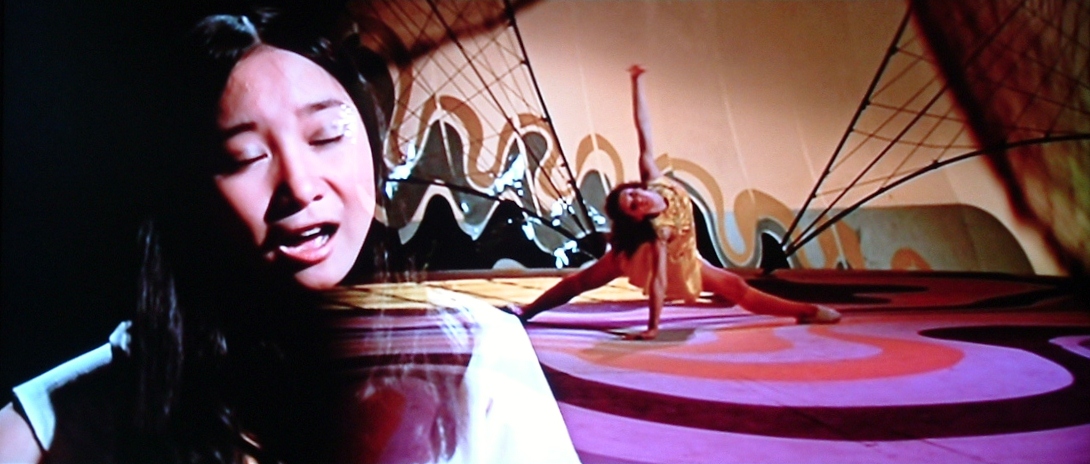
1) The music! For a flick that's designed to appeal to youthful moviegoers, the sound-track is as big as Woodstock: Snoopy's friend, not the festival. After the opening where Chiang does an "edgy" drum solo, we get three watered-down folk songs from Agnes Chan, the younger sister of Irene. She's cute and competently sings (in English) "The Circle Game", "You've Got a Friend" and a bad lyrical rip-off of "What the World Needs Now is Love". Except for an ambitious MTV-like interlude in "YGaF" (pictured), she's showcased with meaningless background dancing and a finale (set during the great anniversary assembly) where she seemingly enters and exits by way of crane or hot air balloon! Another performer (even a mere dude with a guitar) would've added variety to the production, but since Agnes got a HK hit with "TCG", somebody thought she was all the film needed (and could afford). To top it all off, the recordings she lip-syncs to are of a lower fidelity than the rest of the incidental music; to hear how her songs sound, you'd swear records were directly dubbed onto the film's audio track.

2) The "big events!" Besides running too long, the basketball game suffers from bad foley work; where are all the squeaking tennis shoes? (Also, Fan Mei Sheng gets a billing in the movie, yet he's barely seen in his sole appearance as a bench-warmer in the game! Fu Sheng gets more screen-time in all his little cameos combined.) The go cart competition is slightly better with some filming taking place during a real race. Chiang, Lung and Kuan-tai are actually driving in many parts, which is a big plus; only the race's conclusion will make you roll your eyes. The anniversary show is just bizarre, featuring dancing inspired by West Side Story (and a precursor to the dancing in the "Earth" portion of Heaven and Hell), more drumming by Chiang, and little Agnes; it's the HK version of a Judy Garland and Mickey Rooney musical! The karate tournament comes off best as Kuan-tai dazzles all with his skills; Lau Kar Wing and Tong Gaai co-ordinated the fighting action, so all the other principals who had to bust a move here (or in other parts of the picture) were well trained to do so.

3) The "hip" script! Whoever did the lion's share of work on the story, Cheh or Kuang, doesn't matter; there's plenty of blame to go around about the using whatever it took to make YP appear on the "cutting edge" and "with it"... by 1972 standards. The clothes, the walkie talkies, a David Cassidy poster (in Agnes Chan's room), the music (kinda), product placement (7Up, Schweppes and Viceroy cigarettes), go carts and a dune buggy add to your viewing enjoyment by being so woefully out of date from the first day YP played in HK cinemas right into the 21st century. Anyone who has attended college in the past 30 years knows the only bit of college they got right in YP is when Chiang and his friends take a beer break!


Though the main characters in YP are stereotypes, all that unfolds in almost two hours' time doesn't stoop to the level of an Archie comic. (Wu Ma with a "crown" like Jughead's would be too much.) The plot (and the humor) seems to have been inspired (or stolen) from American International's "beach" movies (with Frankie Avalon and Annette Funicello), especially Beach Blanket Bingo. (Observe the comedic fight of the jocks against the martial artists, and substitute go carts for skydiving.) In fact, this is the only Cheh movie that could be rated PG (PG-13 if you think the violence harsh) by today's standards, so if you have to play a Chang Cheh film with your grandma present, this is the one. Those who prefer their "yang gang" fix with Shaw blood all over the widescreen will want to pass on this.

The IVL DVD is the usual slick, bare bones package. An original HK trailer would've provided some insight in how YP was sold to movie patrons back in '72, but all the promos on the disc are produced by Celestial. The new English subs are hilarious in two spots where the Mandarin translator throws in more recent slang; relish Ti Lung saying "homeboy" and "hommie" (SIC)!

After Susanna, YP is one of my favorite Shaw "guilty pleasures." If you don't try to compare it to Animal House or The Paper Chase, you'll have a good time wondering how Chang Cheh became the unofficial spokesman for the younger generation of Hong Kong...if not the world!

Recommended by Brother Fang!

Keeping it trivial....

Fang Shih-yu, Shaolin Temple.

P.S. - Purchase it from PlayAsia by clicking here..

Friday, October 1, 2010

Men From the Monastery (1974), starring Fu Sheng, Chi Kuan-chi and Chen Kuan-tai. Directed by Chang Cheh.

DIRECTOR Chang Cheh must have had some regrets about making Men From the Monastery; why else would he rework such substantial pieces of it into The Shaolin Avengers and Shaolin Temple (both 1976)?

Of all Cheh's eight films in his "Shaolin cycle", MFtM is the one most devalued, if most of all of the written critiques I've read about it is any indication. I feel this may be an excessive judgement. If this can be considered a lesser Cheh effort, it's one that's more entertaining than the flawed attempts at experimentation like The Fantastic Magic Baby (1975) or Heaven and Hell (1978). It also includes the full-fledged debut of a Shaw favorite; more on him in a little bit.


The story is divided into four chapters, the first one featuring Fang Shih-yu (Fu Sheng). Fang attempts to leave the Shaolin Temple, and after clearing the wooden men alley, one of the two brothers on guard, Chen Si Di (Tung Choi Bo), tries to stab Fang before he departs. The other brother on duty takes the knife for Fang, allowing him to escape. Chen tells fellow Qing loyalist Feng Dao De (Lo Dik) of his failure to stop him, and they both go to Zhi Shan, the abbot, to try pinning the murder on Fang. The abbot doesn't believe them for a minute, so on advice from their fellow Shaolin traitor, Brother White Brow, they decide to return to the Wu Dang Martial Arts School and deal with Fang later, White Brow plotting to take care of the abbot another day.

Fang goes to a nearby town to look up an old friend, He Da Yong; from him, Fang learns his old Qing nemesis, Lei Lao Hu, has been practicing pile formation (pole) fighting while he was away at the temple; he's killed two people already. Fang's pal offers to help him with the basics of the formation, but he's murdered by Lei's men the next day as he chops down a tree for a pole. Fang retaliates; he slays Lei's men and quickly hunts down Lei himself, who's waiting for him atop his own pole formation (with sharp bamboo spikes along the ground below, ready for those unfortunate to fall and be impaled on them). Despite a lack of experience on the poles, Fang triumphs over Lei with what he learned from Shaolin.


The second chapter spotlights Hu Hui-chien (Chi Kuan-chi). In Guangzhou, two outlaw Qing symphathizers (instructors from the Jing Lung Martial Arts School) kill Hu's father (Wu Chih-ching), and he wants revenge. His determination is better than his martial arts skills, and he endures their repeated trouncings, even a near drowning where he gets rescued by his girlfriend, Li Cui Ping. Fang intervenes during another ill-advised fight, and he suggests to Hu some time at the Shaolin Temple will help him to defeat them.

Three years later, Hu leaves the temple, and with minor assistance from Fang, he turns the tables on his tormentors, wrecking the Jing Lung school and beating up the troublesome instructors. In a final move to make an example out of the two, he brings them back to the school in front of the students still around, stating these murdering thugs are from the Wu Dang school and are allied with Feng Dao De. The school can still operate, but if they ever cause trouble like their instructors, he'll beat them up, too. As the two suddenly jump up for another attack, he swiftly kills them, their death bringing home to all who witness it the earnestness of Hu's message.


The third chapter focuses on Hung Tsi-kwan (Chen Kuan-tai). After Hung manages to slip out of a brothel before a band of Qing soldiers led by Lei Da Pang (Wang Ching) can catch him, he goes off to convene a meeting of Shaolin disciples where he tells all in attendance that they must look for more men who oppose the Qing.

Prior to the meeting, he met up with two disciples on the road (one of them played by Bruce Tong), who were soon discovered to have been tailed by Lei and his men. Hung and the small group of Shaolin men got every Qing but Lei, who fled the scene when the going got tough.

Presently, Lei reports what occurred to his superior, Gao Jin Zhong (Kong Do). Angered, Gao gives the order to burn down the Shaolin Temple and to begin hunting down and exterminating the fugitives.


The final chapter (titled Men From the Monastery) wraps things all up. After the temple is burned down, and the abbot is killed by White Brow, the assembled Shaolin disciples split up to keep ahead of the Qing. An attempt to hole up on a Chinese Opera troupe's boat is foiled by Lei and his men. Li escapes, and two of the Qing, posing as rebels, go with her to find Hung and the others, one of the men leaving trail markers for the other Qing to follow. Li is on to their ruse; she leads them to the Shaolin men, but they are killed before they have a chance to report back to Gao and Lei.

The Qing lose track of the disciples until Chen Si Di spies two of them transporting sacks of rice to an abandoned temple where Hung and the others are hiding out. Upon hearing this news, Gao and Lei mobilize their men and go to eradicate the Shaolin rebels. As for Feng Dao De, he's along to take out only one of them: Fang Shih-yu....

After that...NO "SPOILERS"!


I have no trouble with the general story as structured by Cheh and writer Ni Kuang; the plot is slightly overrun by the action, but not to extremes. The lack of characterization doesn't hurt here because the pace is fast enough you never get the chance to dwell on it. For continuity buffs, however, the thread of familiarity connecting MFtM to Heroes Two will drive some nuts. Cast members, standing sets and outdoor locations used in HT that show up here again are not always redressed well, though some of the returning actors actually get (arguably) better parts in this! For anyone used to the conventions of low-budgeted movies, all of this just adds to the enjoyment factor, including good photography and well-selected music cues.

The main sticking point to many is the contribution Lau Kar Leung (with Tong Gaai) brings to the fight choreography. While it's not lacking in action, it is missing a lot of the moves of the "Hung Fist" style. What got spotlighted in HT got over-looked here. It's an apparent oversight (caught after the fact) that did not happen again in the other sequels. Even so, "heroic bloodshed" is in abundance and doesn't disappoint; cuts to black & white film and red tints are part of the film's bloody climax.

While Chen Kuan-tai returns as Hung, his prescence in the story is reduced (the bulk of it carried by Fu Sheng and Chi Kuan-chi), which disappointed me some, but he does have his moments here. (Executioners from Shaolin would let him encore Hung a final time in a more memorable way.) Fu Sheng continues to shine as Fang, and his pole-fighting sequence is a well-edited highlight; there's more tension felt with the close and low shots than what the re-staging had in The Shaolin Avengers. Chi Kuan-chi manages to make a good impression in his first big part as Hu, even if it's somewhat laughable (and implausible) to see this muscular fighting machine get his butt handed to him earlier in his segment! Once he's in the temple, he becomes that more familiar, upstoppable "force of nature" with dazzling moves. He doesn't get to show much dramatic range here, but he plays his part capably.

The rest of the supporting cast are comparably good. Among the heavies, even though Kong Do's role is of the highest-ranking Qing, no one actor dominates overall. All of them have limited screen time, so the villainy is rather diluted; Lo Dik as Feng caught my attention out of all of them. I wish I knew the names of the ladies who played Li (Hu's girlfriend) and Hung Ying (the woman Hung was with at the brothel); they both had plum parts here where they weren't submissive victims. (If anyone does know who they are, drop a note here in a comment!)

The rudimentary nice assemblage of the IVL DVD is given a boost in the "extras" department with the original trailer included. The main presentation has a very good anamorphic picture and clear, strong mono audio (Mandarin language); unless Tokyo Shock considers making it a future release, this is as good as the movie's gonna get.

MFtM is not a bad film; it just presses the limits of its modest budget and limited production schedule by cramming so much into an hour and a half. That this "rush job" would spur Cheh on to revisit the material (by spreading it out over two movies) makes sense. Still, MFtM succeeds through the majority of its parts (if not as a whole), and there's a mess of them, so that's the cinematic equilvalent of a high batting average. To take the baseball analogy further, it's not so much a "grand slam" as it is a hit that gets you to third base, and that's not bad at all!

More for fans of Fu Sheng and Chi Kuan-chi than for you Chen Kuan-tai lovers! Otherwise, complete your "Shaolin cycle" collection with this! Recommended by Brother Fang!

Keeping it trivial....

Fang Shih-yu, Shaolin Temple.

P.S. - Purchase it from Play-Asia by clicking on here.

Friday, August 13, 2010

Heroes Two (1974; Blu-ray edition), starring Fu Sheng and Chen Kuan-tai. Directed by Chang Cheh.

SORRY about the delay for the second entry; I had so many ideas as to what this installment had to be, I got myself in a bit of a pickle, deciding which one to use next. Luckily, this reissue popped up on Tuesday from the fine people at Media Blasters (under their Tokyo Shock imprint), only a week past the second announced release date for this Blu-ray version of a popular film from the unique movie sub-genre that is Hong Kong action cinema. Considering how the end product turned out, any delays MB had taken in doing this movie proper turns out to be justified!

In terms of "old school" martial arts movies, many have seen Heroes Two (1974), the first of director Chang Cheh's "Shaolin cycle" of movies, less as a classic and more as a "quickie" mainly because how fast it was put together. (It was being filmed concurrently with what would be the sequel, Men from the Monastery, also 1974.) Cheh had his own film production company in Taiwan set up at the time, and he was under pressure from Shaw Brothers to make hit movies for them at a fraction of the cost of an epic like his own The Water Margin (1972; co-directed with Wu Ma and Pao Hsueh-li).

Possibly due to fight choreographer Lau Kar Leung's proficiency in the "Hung Fist" martial art, Cheh picked up on some old Chinese history and the account of how a student of the Shaolin Temple, Hung Hsi-kwan, wound up developing his namesake martial art that is still practiced today. (Or was Cheh inspired by The Prodigal Boxer, an independent release from '73, which is an earlier telling of the story of Fang Shih-yu, played by Meng Fei? The film is full of Shaw regulars and features as an action director Lau Kar Wing, younger brother of LKL.) Cheh covered the stories of Hung and fellow Shaolin heroes (like Fang and Hu Hui-chien) in four of the eight movies he would make in this series. (The other three were new stories with new characters, and people like Hung would only be mentioned by name.) After Cheh and his co-scripter Ni Kuang, the three constants in these films were the usage of authentic martial arts styles (primarily Hung fist, of course, but even this was stylized for the movies) and actors Fu Sheng and Chi Kuan-chi (Kuan-chi's only a background player in HT, however). While not an epic in scale and its execution, it still contains an epic's worth of fun, thrills and "heroic bloodshed".

HT begins with a wounded Hung Hsi-kwan (Chen Kuan-tai) killing Manchus as he escapes from the burning down of the Shaolin Temple; the Manchus, led by General Che (Chu Mu), begin to hunt him down in hopes of finding out where more Shaolin escapees may be.

As sure as Hung's outfit is black, we soon see another Shaolin fugitive clad in white, Fang Shih-yu (Fu Sheng), who gives off a strong air of righteousness that borders on arrogance in his capacity of being a hero. (The moment anyone finds out his name, they readily know who they're dealing with, such is his reputation.) More importantly, despite both being from the temple, Fang and Hung have yet to meet. (It's conveyed Hung was in and out of the temple often, compared to Fang.)

Because of this, the Manchus easily convince Fang that Hung is a thief and murderer they're trying to catch; not long afterward, he unwittingly helps them to nab him.

With Hung taken to a nearby town and imprisoned in the basement of a Manchu sympathizer, word spreads of Fang's deed as he arrives in the same locale to see Li Shih-chung (Wu Chi-ching), a friend and Shaolin sympathizer who has a number of refugees staying at his residence. After a skirmish with the guys over the misunderstanding, Fang realizes the big mistake he has made; upon finding out about Hung's location in town, he attempts to free Hung, and he fails, barely escaping the Manchus after enduring two nasty blows from General Che.

After a quick recovery, Fang (starting from the Shaolin "safehouse") manages to dig a tunnel to Hung in just over a week's time (!) and frees him. Che and his men investigate the escape, eventually finding Hung, Fang and the other Shaolin fugitives waiting for them on a steep hill outside of town, ready to take out the Manchus permanently in a final showdown. Che (in his position as the head creep) comes prepared, surrounding the rebels with extra forces and bringing along a few "old friends" (some monks who practice Tibetan martial arts like the general does) to help eradicate the troublemakers quickly. Or do they?

NO "SPOILERS"!

After using The Deadly Duo as a "test run" for BD production, Tokyo Shock pulls off true HD versions (yes, 1080p) of HT and the Three Styles of Hung Fist featurette in fine fashion. If you thought the TS DVD looked great, be prepared to be further wowed with the BD.

Minor flaws inherent in the source materials aside (TSoHF is in better condition than HT), the Blu-ray format breathes new life into these films; it helps emphasize even the smallest of details, ranging from a stronger clarity to the all the sweating the actors did during filming (indoors and out) to facial expressions! (The late Fu Sheng's acting benefits most from the process.)

Audio options are the same as found on the DVD (notably, the commentary track by the late Linn Haynes is given a credit on the packaging); the English subtitles are still yellow, but they're now of a different, smaller font that doesn't block the screen like the subs on the DVD. (The translation is unchanged from the DVD, too.)

As for the special features, the majority of the ones from the DVD make it to the BD, and TS throws in additional ones for the people who've decided to trade up to the more "expensive" model! Most notable of them all are the Celestial Pictures edit of TSoHF (with language options) and the original Chinese opening titles to HT, including the logo for Cheh's film company (yes, it's Chi Kuan-chi pulling back that bow)!

Unfortunately, the English trailer (un-remastered with German subs) and that first Chinese version of the opening are non-anamorphic, which was somewhat a disappointment for me, but I think anybody can live with this arrangement as what most of us want is the short and the feature in HD. Even so, I know I can't be the only who'd love it if TS had built in a playback option where the original Chinese opening (made anamorphic) could be combined with the remastered film for the best approximation of the HK movie-going experience back in 1974. (You'll need to adjust the screen on your LCD TV in order to look at the English trailer in a non-distorted way.)

A must-have for all fans of Fu Sheng, Chang Cheh and "old school" martial arts movies!

Keeping it trivial....

Fang Shih-yu, Shaolin Temple.

P.S. - Purchase it from Amazon by clicking on here: Heroes Two (Blu-ray)