Powered By Blogger
Showing posts with label Irene Chan. Show all posts

Friday, November 30, 2012

Shaolin Martial Arts (1974), starring Fu Sheng, Chi Kuan Chun, Gordon Liu Chia Hui, Bruce Tong Yim Chaan, Irene Chan Yi Ling, Leung Kar Yan and Johnny Wang Lung Wei. Directed by Chang Cheh.

All images courtesy Celestial Pictures.
FOR anyone who likes their Shaw Brothers flicks with Shaolin kung fu, Shaolin Martial Arts will live up to its name for you adequately. The third of four Shaolin-based films made by director Chang Cheh to be released in 1974, it initially attracted moviegoers because of the pairing of rising stars Fu Sheng and Chi Kuan Chun, but it's since been rediscovered in the home video age for the early presence of popular performers Gordon Liu (not yet shaving his head), Leung Kar Yan (not yet sporting a beard) and Wang Lung Wei (not yet using a finger to make his point). With a script by Cheh and the prolific Ni Kuang that deviates some from the convention found in most of these films, it catches the viewer's attention with a low-key, moody story.

Lau Kar Wing
Long after the Shaolin Temple has been burnt down (heroes like Fang Shih-yu and Hung Tsi-qwan are mentioned in the past tense), the Qing court gets word from the province of Guangdong of the discovery of Shaolin rebels at a kung fu school run by Lin Zan Tian (Lo Dik). They arrange to have Wu Chung Ping (Kong Do) open and manage a Manchu school nearby, using it as a subterfuge for rooting out the fugitives. The Manchus finally strike at a ceremony jointly attended by the schools, killing a Shaolin student (Lau Kar Wing) in order to provoke a fight, but their strategy backfires when the agitators trounce the Manchus, including Ping. Not surprisingly, once the Qing authorities arrive, they side with the Manchus, claiming nothing more happened than a "gang fight", thus denying the Shaolin men justice for their slain brother.

left to right: Leung Kar Yan and Johnny Wang Lung Wei
Disappointed Ping and his pupils failed to defeat the rebels, a Qing general (Lee Wan Chung) offers Ping some assistance via his confidante, kung fu master He Lian (Fung Hak On). Lian has summoned his two favorite disciples to help the Manchus eradicate the Shaolin agitators: Ba Kang (Leung Kar Yan) and Yu Pi (Johnny Wang Lung Wei). Kang is highly trained at Steel Armor kung fu, which makes his skin tough and invulnerable to blows; Pi has mastered Qi Gong, which enables him to withstand a blow from an opponent and "rebound the power of the blow", injuring "the one who initiated the punch."

top, left to right: Fu Sheng and Chi Kuan Chun
below, left to right: Bruce Tong Yim Chaan,
Tino Wong Chueng and Gordon Liu Chia Hui
Soon enough, the dissidents find out Kang and Pi are forces not to be trifled with when the duo leads a group of Manchus on a visit to Tian's school; once there, they kill his two best students in brief, one-sided matches. Among those who witness the spectacle are Shaolin aspirants Li Yao (Fu Sheng), Chen Bao Rong (Chi Kuan Chun), He Zhen Gang (Gordon Liu Chia Hui) and Mai Han (Bruce Tong Yim Chaan). Knowing they're in over their heads if they fight this deadly twosome, they flee from the Manchus and report what's transpired to the ailing Tian, who lives in seclusion with his daughter, Lin Zhen Ziou (Irene Chan Yi Ling), and his niece, Ah Wai (Yuen Man Tzu).

Lo Dik
Once he's been updated, Tian knows exactly what kind of kung fu they're dealing with, and he believes the Eagle Claw and Rolling Eagle Claw styles will best take out Kang and Pi, respectively. However, he's no expert on those martial arts, so he has Gang and Han go to a reclusive sifu known as the "King of Eagle Claw" (Chiang Nan) for a few months of special training, while Yao and Rong stay with him and continue their Shaolin training.

Eventually, Gang and Han complete their training, but on the way back to see Tian, they get word four Shaolin students have been recently captured by the Manchus, prompting them to go into rescue mode. For an instant, it looks like their new abilities put them on equal footing with Kang and Pi, but they fall short of that. Gang and Han are killed, but the pupils manage to escape the Manchus' grasp and tell Tian about the bad turn of events.

left to right: Simon Yuen Sui Tien and Feng Yi 
Realizing he tragically underestimated Kang and Pi's advanced skills, Tian has Yao and Rong seek out two other sifus whose areas of expertise may be more helpful toward ending the murderers' reign of terror. Yao goes to Master Liang (Simon Yuen Sui Tien) to learn Tiger and Crane Fist (to stop Kang), while Rong locates Master Yan (Feng Yi) so he can learn Wing Chung (to stop Pi). In the beginning, the workouts are long, tiring and exasperating (Yao has to wait a whole month before Liang agrees to work with him!) to the point both consider quitting, but they quickly change their minds once Ziou and Wai disclose how Tian defiantly committed suicide when Kang, Pi and the Manchus came calling on him not long after they left. Now refocused, the young men dive into the training with a passion. Months later, Yao and Rong, eager to avenge the deaths of Tian and their many Shaolin brothers, are finally prepared for a showdown with Kang and Pi, mano-a-mano....

top, left to right: Irene Chan Yi Ling and Yuen Man Tzu
bottom, left to right: Kong Do and Funk Hak On
As a whole, Cheh and Kuang's screenplay for SMA doesn't get mired in formula because the formula is a work in progress. The narrative fares better when shown from the viewpoint of the Shaolin rebels. Vicariously, we feel their anger when their comrades are slain; their camaraderie as they hide out from the Manchus; and their disappointment and elation as they go through the rigors of learning kung fu. What doesn't come off as well are the villains. Kang and Pi are intimidating enough, but their limited screen time lessens their menace; with Ping and Lian, their roles are way underdeveloped, and a good rewrite could drop either of them without harm to the story. Some have reserved their loudest complaints for Ziou and Wai. It's possible the women were added at the suggestion of the Shaws (the romantic angle is played up in the original movie trailer, included on the IVL DVD), over the objections of director Cheh. (Did Kuang write them in?) I have no hangups about the ladies (though their girlish behavior is laid on thick), and it's to the credit of Kuang and/or Cheh they're not depicted as damsels in distress.

Despite having young ladies in his yang gang scenario, Cheh directs SMA assuredly, with as much attention given to the pensive moments as are the boisterous ones. The photography by Miyaki Yukio (Kung Mu To) helps to set the proper atmosphere, particularly with a good usage of darkness in well composed low-lit scenes. Kwok Ting Hung's editing is adroit, enhancing the grace, beauty and intensity Lau Kar Leung and Tong Gaii bring to the choreography of the training sequences and the fights. (Only the climatic battle ends with a whimper, but that's more of another script problem.)

The cast handles their parts capably. Fu Sheng and Chi Kuan Chun make a great team, both at (or near) their physical peaks, and while Chun gets his fair share of acting opportunities (and is very good), Sheng carries the picture with his winning personality and an underplayed performance, even during his comedic scenes with the winsome Yuen Man Tzu. Irene Chan Yi Ling (forever "Princess" in Cheh's Young People) shows impressive range in what time she gets to be seen as Tian's daughter (and Rong's girlfriend). Lo Dik, Feng Yi, Chiang Nan and Simon Yuen Sui Tien are great as the Shaolin sifus, with Tien a true scene stealer as the obstinate Liang, who gives Yao no mercy. Supporting player Bruce Tong Yim Chaan gets a rare weighty role as the Shaolin student fated to die at the hands of Pi; why this above average actor and fighter didn't get a chance at stardom is mystifying. As already noted, Kong Do (Ping) and Fung Hak On (Lian) are given skimpy roles, but they give enough of a spark to them they don't come across as cardboard cutouts. As always, other familiar Shaw faces are present throughout, including the likes of Tino Wong Chueng, Dang Tak Chueng, Chan Dik Hak, Li Chen Piao, Lo Wai and Lam Fai Wong.

left to right: ? and Leung Kar Yan
What about those three newcomers mentioned earlier? For Leung Kar Yan and Lang Lung Wei, SMA was their second Shaw movie (but the first to be issued), while Gordon Liu had a few more films under his belt prior to this one. So it stands Liu is the more accomplished actor and gets to show off his kung fu capabilities in a memorable fight with Yan, demonstrating his potential as star material years before he got his big break with The 36th Chamber of Shaolin. As the efficient killing machines, Yan and Wei play don't get to display any depth but they are convincingly tough. However, Yan arguably gets the meatier role as Kang, highlighted by one of the movie's best scenes where a prostitute's attempt to arouse him fails because, thanks to his Steel Armor training, he's capable of retracting his sex organs into his body cavity!

The IVL DVD is the best way to experience SMA. It boasts a remastered, anamorphic picture, the original mono Mandarin soundtrack and English subtitles. Extras consist of bios and newly made Shaw trailers by Celestial Pictures. (I first saw this years back in bootleg form with the English dub, which I didn't like much, thanks to the overly sweet voices given to Ziou and Wai. Seriously, you get a better feel for the emotional tone of the movie if you see the legit DVD. Watch that, not the bootleg.)

SMA is early in Cheh's "Shaolin Cycle", and it has the bumps in the script to prove it. Fortunately, the modest imbalance (a.k.a. the weak villainy) doesn't hurt what is an exciting and fun (even thoughtful) film. Most of all, with Fu Sheng, Chi Kuan Chun, Gordon Liu, Leung Kar Yan and Lang Lung Wei participating, it's definitely not boring.

Brother Fang cuts to the chase: "A special dose of Shaolin, featuring the ascending Fu Sheng and early looks at Gordon Liu, "Beardy" and Lang Lung Wei. Recommended!"


Keeping it trivial....

Brother Fang, Shaolin Temple.

Saturday, December 4, 2010

Young People (1972), starring David Chiang, Ti Lung and Chen Kuan-tai. Directed by Chang Cheh.


WHOEVER is still holding out on purchasing a copy of Young People for non-economical reasons, let me reassure you that as widespread as the opinions are on the Shaw Brothers film, this is a special release from director Chang Cheh and script co-writer Ni Kuang worth getting. After its availability as a download (and an illegal one at that), what are the chances this will seriously be reissued again on DVD or VCD (even BD) after it goes out-of-print? Even though Cheh has a following around the globe, it's not a huge one, so it's probable his lesser-known releases shall fade away into the ages, while newer generations of fans and film scholars will dissect a selection of his movies (like One-Armed Swordsman, Vengeance!, The Duel or The Five Venoms) ad nauseam. If you feel my theory has some merit, then buy Young People now, 'cuz the window of opportunity may be closing.

Flavored with a lot of location filming at Chung Chi College (a Christian college founded in 1951, affiliated with the Chinese University of Hong Kong), YP is Cheh and Kuang's scattershot attempt to understand college-age young adults. (Our heroes are never seen in classes, by the way.) They are all over the map when comes to their presentation of what they think makes the minds of men and women in their earlier twenties tick. YP can only be safely classified as a Cheh movie; to categorize it as something else is pointless because it's fragments of genres and homages to other films, all of them tied together with a very basic plot.

To simplify the story, which has been re-counted many times in other reviews, it's the jocks (led by Ti Lung) versus the martial arts club (led by Chen Kuan-tai), with the performing arts club (led by neo-hippie David Chiang) somewhere in the middle. While the basketball players and purveyors of kung fu vie for the school's honor (not to mention Lung and Kuan-tai competing for the charms of fickle Irene Chan), the dancers and "band geeks" prepare for the school's anniversary celebration. How does Chiang unite these two hot-headed guys in friendship? Through peace, go carts and dance choreography!

So, what is there to enjoy in YP? Let's start with some intentional things:

1) Irene Chan! From her first scene onward, she makes you want to see the movie to the end. Anyone who has said there isn't any comedy in this wasn't paying attention to her work. The sequence where she barges into the mens' locker room before the big basketball game is a riot; her facial ex-pressions as the guys hurriedly cover up are priceless. She goes from Kuan-tai to Lung (and back to Kuan-tai) without much thought put into it beyond the fact they won trophies, which seems to be what draws her to them. When she loses both guys, you know she deserves this comeuppance, yet you can't help but feel sorry for her because for all her charms, she's still a ways off from being  a mature woman. Chan's combination of sexiness and fine acting in the role of Princess is one of the better peformances of a leading lady in any Cheh movie out there.

2) Bolo Yeung! One favorite Bruce Lee nemesis is (mostly) cast against type as one of the jocks. Not only can he play basketball, he is also adept at comedy; his scene where he and Wong Chung make fun of Kuan-tai's speech patterns (he speaks no more than three words at a time) is pure goofy fun. He's a sight to see with his crewcut and wearing those way-out '70s fashions. (Dig that visor!) He's not a constant presence in the picture, but when he's on, he easily catches your attention in an atypical part.

3) "The Blood Brothers!" Well, at the time, Lung, Chiang and Kuan-tai were yet to be in that '73 film, but if you happen to watch TBB after seeing YP, you'll never look at the former movie again in quite the same way. The guys are cast to type; Lung is the BMOC, Kuan-tai is the soft-spoken karate expert and Chiang is the drummer who feels all the world needs now is love, sweet love. As silly as the film is, the trio give their all and make the situations feel somewhat plausible. (If you think Lung is bad in this, please reacquaint yourself with his spot-on John Cassavettes imitation in Black Magic [1975], and stand corrected!)

What elements enhance YP by accident, if not design? They would be:

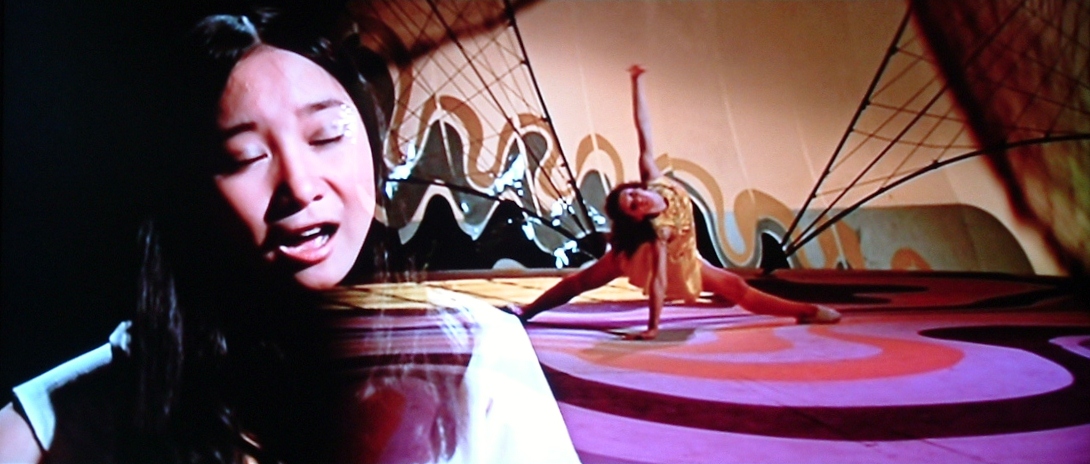
1) The music! For a flick that's designed to appeal to youthful moviegoers, the sound-track is as big as Woodstock: Snoopy's friend, not the festival. After the opening where Chiang does an "edgy" drum solo, we get three watered-down folk songs from Agnes Chan, the younger sister of Irene. She's cute and competently sings (in English) "The Circle Game", "You've Got a Friend" and a bad lyrical rip-off of "What the World Needs Now is Love". Except for an ambitious MTV-like interlude in "YGaF" (pictured), she's showcased with meaningless background dancing and a finale (set during the great anniversary assembly) where she seemingly enters and exits by way of crane or hot air balloon! Another performer (even a mere dude with a guitar) would've added variety to the production, but since Agnes got a HK hit with "TCG", somebody thought she was all the film needed (and could afford). To top it all off, the recordings she lip-syncs to are of a lower fidelity than the rest of the incidental music; to hear how her songs sound, you'd swear records were directly dubbed onto the film's audio track.

2) The "big events!" Besides running too long, the basketball game suffers from bad foley work; where are all the squeaking tennis shoes? (Also, Fan Mei Sheng gets a billing in the movie, yet he's barely seen in his sole appearance as a bench-warmer in the game! Fu Sheng gets more screen-time in all his little cameos combined.) The go cart competition is slightly better with some filming taking place during a real race. Chiang, Lung and Kuan-tai are actually driving in many parts, which is a big plus; only the race's conclusion will make you roll your eyes. The anniversary show is just bizarre, featuring dancing inspired by West Side Story (and a precursor to the dancing in the "Earth" portion of Heaven and Hell), more drumming by Chiang, and little Agnes; it's the HK version of a Judy Garland and Mickey Rooney musical! The karate tournament comes off best as Kuan-tai dazzles all with his skills; Lau Kar Wing and Tong Gaai co-ordinated the fighting action, so all the other principals who had to bust a move here (or in other parts of the picture) were well trained to do so.

3) The "hip" script! Whoever did the lion's share of work on the story, Cheh or Kuang, doesn't matter; there's plenty of blame to go around about the using whatever it took to make YP appear on the "cutting edge" and "with it"... by 1972 standards. The clothes, the walkie talkies, a David Cassidy poster (in Agnes Chan's room), the music (kinda), product placement (7Up, Schweppes and Viceroy cigarettes), go carts and a dune buggy add to your viewing enjoyment by being so woefully out of date from the first day YP played in HK cinemas right into the 21st century. Anyone who has attended college in the past 30 years knows the only bit of college they got right in YP is when Chiang and his friends take a beer break!


Though the main characters in YP are stereotypes, all that unfolds in almost two hours' time doesn't stoop to the level of an Archie comic. (Wu Ma with a "crown" like Jughead's would be too much.) The plot (and the humor) seems to have been inspired (or stolen) from American International's "beach" movies (with Frankie Avalon and Annette Funicello), especially Beach Blanket Bingo. (Observe the comedic fight of the jocks against the martial artists, and substitute go carts for skydiving.) In fact, this is the only Cheh movie that could be rated PG (PG-13 if you think the violence harsh) by today's standards, so if you have to play a Chang Cheh film with your grandma present, this is the one. Those who prefer their "yang gang" fix with Shaw blood all over the widescreen will want to pass on this.

The IVL DVD is the usual slick, bare bones package. An original HK trailer would've provided some insight in how YP was sold to movie patrons back in '72, but all the promos on the disc are produced by Celestial. The new English subs are hilarious in two spots where the Mandarin translator throws in more recent slang; relish Ti Lung saying "homeboy" and "hommie" (SIC)!

After Susanna, YP is one of my favorite Shaw "guilty pleasures." If you don't try to compare it to Animal House or The Paper Chase, you'll have a good time wondering how Chang Cheh became the unofficial spokesman for the younger generation of Hong Kong...if not the world!

Recommended by Brother Fang!

Keeping it trivial....

Fang Shih-yu, Shaolin Temple.

P.S. - Purchase it from PlayAsia by clicking here..