Powered By Blogger
Showing posts with label Tung Lin. Show all posts

Thursday, March 10, 2011

Police Force (1973), starring Wong Chung, Lily Li, and Fu Sheng. Directed by Chang Cheh and Tsai Yang-ming.

(All images courtesy Celestial Pictures.)

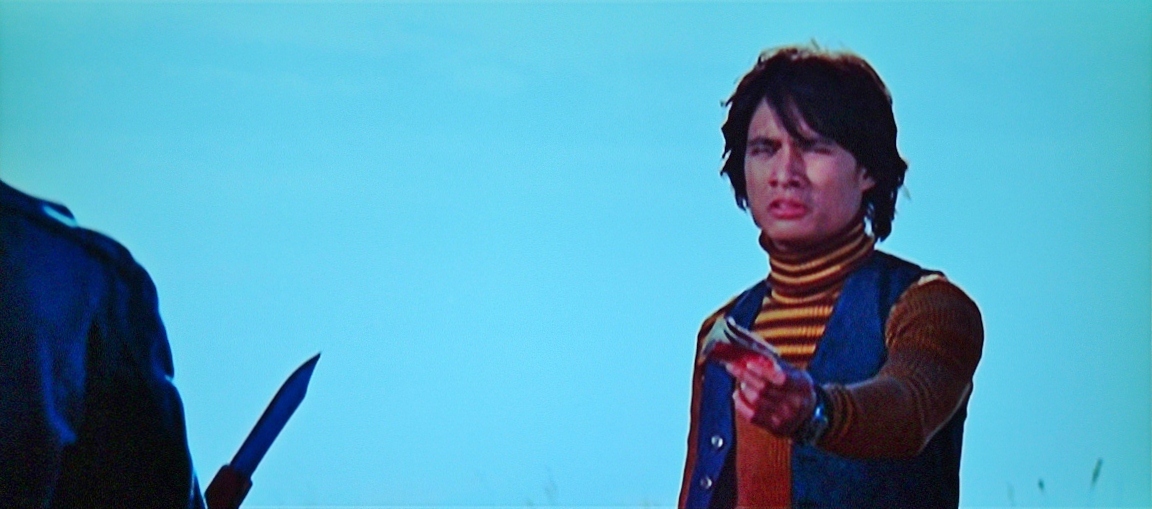
ALLOW me to make a statement that can be considered a lesser form of heresy: if there were no Fu Sheng in Police Force, this Shaw Brothers movie would be no less watchable than it is now. Anyone could've been cast in his part, and fortunately for Sheng, Chang Cheh saw something in this newcomer and gave him those fabled fourteen-plus minutes at the beginning. Whether he was intentionally offering a taste of Sheng to pique the interest of HK moviegoers or hedging his bets by limiting Sheng's involvement in the film, that's unknown, but we certainly have an idea what happened to Sheng after its release (eventually). For now, Cheh's goal was trying to establish Wong Chung as a star, and months after audiences watched him play a juvenile delinquent, they now got to see him in the mature role of a cop (his first of many) in this "slice-of-the-'70s" crime drama, filmed with the cooperation of the (then) Royal Hong Kong Police Force.

The plot of PF is an uncomplicated one. When Liang Guan (Fu Sheng) is murdered while protecting his girlfrend, Shen Yan (Lily Li), from harm during a robbery gone awry, his best friend, Huang Guodong (Wong Chung), decides to join the HK Police Force, vowing to Yan he will track down the perpetrator and kill him in an act of revenge.

In five years, Guodong goes from being a cadet to Inspector, and when he discovers a recent police sketch of a man spotted dumping a body matches the one made of Guan's murderer, his most important manhunt begins in earnest.

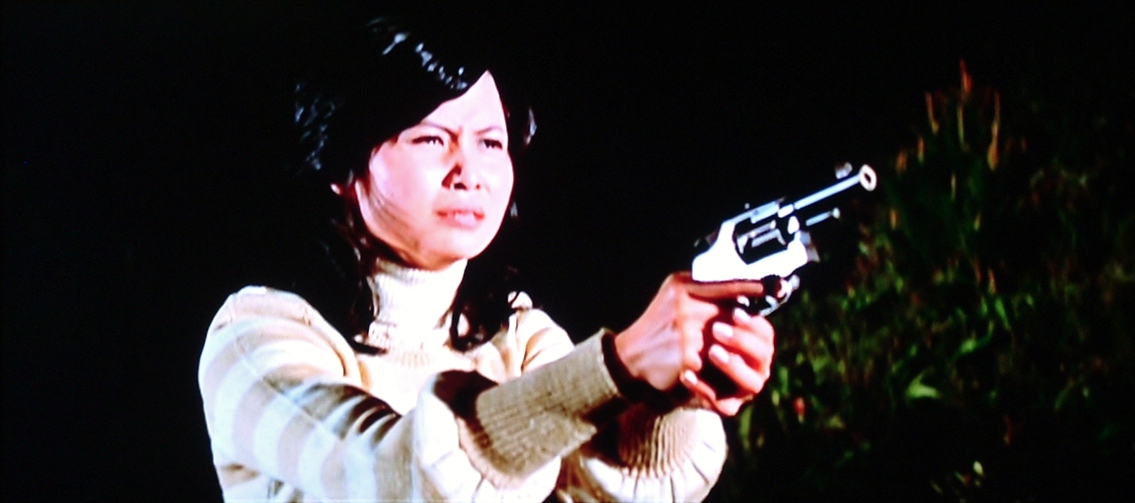
The suspect, Gao Tu (Wong Kuong Yue), is soon found out to be connected with one Sun Zuozhong (Wang Hsieh), and the last thing the counterfeiter needs is the police bugging him because of this association. Soon, Tu's a marked man, and it's Guodong who saves him from being killed by some of Zuozhong's men. When Yan (with Guodong at the time, coincidentally) confirms Tu's ID, Guodong's moment to avenge Guan's death has arrived, but he realizes he can't do it because he is a policeman; Tu must be used to help bring down Zuozhong's criminal organization. Yan's disappointed in Guodong, but when she gets a chance to shoot Tu dead, she's unable to follow through, knowing Guodong is right.

With Tu in custody and ready to help police investigators, Zuozhong decides it's time to get out of HK, and he begins to flee on his yacht, hoping to escape to international waters. Guodong sends his four detectives off on a fast boat to pursue him (taking Tu along to help identify the yacht), while he gets on a police helicopter and flies off after them to provide backup....


After an intense release like The Delinquent, PF seems subdued, by comparison, but considering the movie was made with the blessing of the HKPF, there's little doubt they had final script approval. This is why parts of the screenplay by Cheh and Ni Kuang feel like a recruiting ad, but it's the HKPF's participation that gives authenticity to the police procedures we see within an hour and 41 minutes, as well as make the film look like it cost more to make than what it actually did. Cheh used his access to police buildings, equipment and personnel to positive results.

As for straight drama, while a lot of it is familiar stuff, the movie's pacing never lags, so the cliches don't get to hang around. The exception is Yan; Lily Li makes the most of what's written for her (and models a cool '70s wardrobe), but her character lacks real depth. Only when Yan stops obsessing over her boyfriend's killer to assist Guodong during his investigation does she get to be interesting, but it's too little, too late. To top it all off, she has to go into the old bit of getting cold feet when a choice moment to kill the murderer herself arises, which is the only serious lapse in an otherwise decent story. (What? Not even a flesh wound?) Her departure from the film after Tu's apprehension is abrupt as it is anticlimatic; what a waste of talent.

On PF, Cheh works with another co-director, Tsai Yang-ming, whose first film was the '72 independent production The Prodigal Boxer (a telling of the story of Fang Shih-yu that predates Heroes Two by two years). Cheh's style is so dominant throughout, Yang-ming's contributions are hard to decipher, so it's best to consider it more as a Cheh film. At any rate, he's on top of his craft here, with stylish location shooting in HK and involved action sequences, with fight choreography overseen by Lau Kar Leung and Tong Gaai. Save for a few continuity errors (like a "quick dry" Guodong after a dip in the ocean), this is one of the more slicker Cheh movies set in contemporary (1973) times.

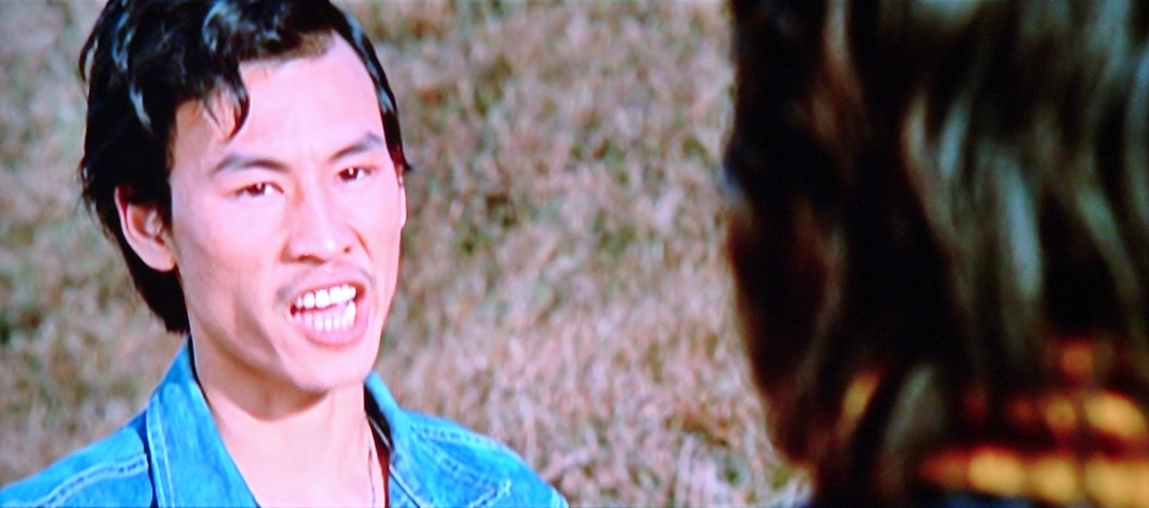
There's a lot of good acting to enjoy here. Wong Chung is is ideal as Guodong, a guy who can smack a felon around along with the best of HK's lawmen. Wang Hsieh (The Lady Hermit) as Zuozhong is menacing like a bulldog, and Tung Lin (The Delinquent) looks properly authoritative as Chung's boss, a senior inspector. Among the many other supporting players, watch out for Fung Ngai (Fist of Fury), Bruce Tong, Teung Tak-cheung and Lee Yung-git. In the offbeat casting category, regular "heavy" Fung Hak-on is fun to watch as Guodong's partner (seen in this screencap with the obligatory ugly jacket).

As for Fu Sheng, he handles his screen debut better than expected. He manages to convey his acting range in what little screentime he has as Guan, and his performance is a natural one. He handles his action scenes equally well; his skills are sharp and focused during his scene at a karate tournament, where he takes on Lau Kar Wing (who appears later in two other minor roles). Guan's established quickly enough as a likeable fellow (and loving boyfriend) that when his death comes at the hands of Tu, it is poignant as he expires in a modern version of "heroic bloodshed", and the nasty nature of hs demise makes the desire for revenge Guodong and Yan share all the more potent.


PF is a transitionary film in the genre of crime dramas, HK style; it's a "last gasp" of an era where characters and situations were defined in terms of "black and white", and it's one of the earlier attempts to bring an audience realism through blood, urban grittiness and antiheroes. Guodong's initial motivation for joining the police force (vengeance) is as emotionally complex as the film gets, and for all the violence there is, it's not elaborately staged and meticulously edited. It's still years away from anything like Police Story or Hard Boiled, so anyone who sees PF on the merit it's a Cheh film should expect an "old school" movie and nothing more. In summary, Wong Chung as a '70s "Supercop" is one hell of an experience worth undertaking.

Brother Fang says..."Chang Cheh, Wong Chung and Fu Sheng: three good reasons to check ths out!"

Keeping it trivial....

Fang Shih-yu, Shaolin Temple.

P.S. - While you still can, purchase it at PlayAsia by clicking here.

Thursday, February 10, 2011

The Delinquent (1973), starring Wong Chung, Lo Dik and Lily Li. Directed by Chang Cheh and Kuei Cheh-hung.

(All images courtesy Celestial Pictures.)

IF Friends can be categorized as a fairy tale (a little Grimm, by some measure), then The Delinquent is pure tragedy. This could be said about more than a few of director Chang Cheh's better-known Shaw Brothers movies (like The Assassin or The Heroic Ones), but The Delinquent towers over them all with its unique, increasingly morose tone. Out of all Cheh's attempts to emulate the angst of the "Reckless Youth" found in Rebel Without a Cause (1955), he succeeds here --exceeds, really-- the best. (James Dean's "Jimmy Stark" in RWaC wouldn't last five minutes in this bleak Hong Kong.) However, he wouldn't have created this triumph without the help of three key people: writer Ni Kuang, co-director Kuei Cheh-hung and actor Wong Chung (in his first leading role).

As the plot generally goes, the teenaged John (Wong Chung) convinces himself the easiest, quickest way he and his father (Lo Dik) can get out of living and working in the HK slums is if he helps Boss Lam (Tung Lin) and his gang of robbers get into Wing Kee Warehouse to clean it out, after which John will be given a generous portion of the profits for his assistance. What complicates matters is his father is the head night-watchman at the warehouse.

While we don't know all of John's backstory, we can guess things started getting tough when his mother (seen in a brief flashback) left home. Apparently, she tired of being a housewife at some point and started going out evenings; his father thought slapping her around would bring her back to reality. It did; she divorced him and married an understanding butcher (Shum Lo). Her subsequent attempts to communicate with John through messages delivered to him by his girlfriend, Elaine (Lily Li), only serve to anger him.

The script rationalizes the father's boorishness to his being head of the household and his reputation around the area for being rough on would-be crooks who've previously tried to break into the warehouse. He wants John to get ahead in the world through hard work and avoiding shortcuts to prosperity. Though John loves his father, he sees the results of all the old man's laboring as a big waste, because it seems he hasn't advanced any further than those who also find time to relax and raise hell once in a while. These days, John is taking after more like his mother, so his father can't help but worry.

Sometime after he's fired from his job at a restaurant for fighting on the streets too much (which always brought the cops to the establishment, to the detriment of their business), John gets word of how Boss Lam needs him so they can infiltrate the warehouse. Lam's underling, Big Sean (Fan Mei Sheng), oversees a brothel, and he offers a woman to John as a means to win him over. Even after a night with her, John can't commit to the deal; when Big Sean then demands immediate payment for sleeping with the lady, John only offers to pay him later. In short order, Big Sean and some of Lam's other men track him down at a beach and beat him up when he decides not to pay at all.

Shortly, John is picked up by the police, and when his father refuses to post bail for him this time, it's Boss Lam who sets him free. Lam now talks directly with John about the proposition, offering him (in addition to money) employment, new clothes, a sports car and time with his girlfriend, Fanny (Pei Ti). It appears Lam doesn't want to mess with John's dad when he suggests to John if he can make his father take time off from work, nothing would happen to him once the caper goes down. John finally agrees to the scheme, and after a reconciliation with him, he persuades his father to take a two-day vacation.

Come the night of the robbery, when John finds out his father is filling in for the now-sick substitute, he quickly finds Lam and his men at a sawmill, telling them to postpone the operation. Of course, he finds out all too soon the deal's off; he's beaten up (again) and is left to have a deadly encounter with a buzzsaw. While John is occupied with escaping from his predicament, Lam and his men rob the warehouse, and in spite of his heroic efforts to stop them, John's father is killed. Upon finding out what all has transpired, John rapidly becomes a revenge-fueled killing machine, taking down Lam's associates one by one before finally confronting Lam himself.


With The Delinquent (released in the US as Street Gangs of Hong Kong), Kuang soloed on the script, writing a sad character study with a strong dose of violence that is always to be expected from a Cheh movie. (Had he done this as a collaboration with Cheh, I'm certain the emphasis would've been more on action.) Limited characterization behind the three lead parts hampers our empathizing with them, to a degree; John is adequately defined, his father has hints of complexity, but Elaine serves no real purpose beyond being rescued by John a couple of times or being an intermediary for him and his mom. (Lily Li gives a good performance, anyway.) Going past these minor problems, Kuang has crafted a cautionary tale where the moral is delivered like a sledgehammer between the eyes.

The original HK trailer for TD (included on the IVL DVD) promised audiences a "NEW KIND OF PRODUCTION" about "THE WRATH OF YOUTH EXPLODING LIKE A VOLCANO" that "WILL MOVIE (sic) YOU......AND EXCITE YOU!" and co-directors Cheh and Cheh-hung gave the people what they wanted. As for their joint effort on TD, it's commonly assumed the directing duties were divided, with Cheh-hung overseeing the dramatic, documentary-like scenes and Cheh handling the ones heavy on action (and his trademark "zoom" shots, though they're actually well-placed here). However, if we know anything of their filmographies, we see both were capable of versatility; based on this, it's more likely Cheh did most of the latter while Cheh-hung did most of the former. It's also possible Cheh saw something particular in Cheh-hung's own films that made him the choice for co-directing TD, because if Cheh had the likes of Wu Ma or Pao Hsueh-li on duty for this, we would not have had the level of emotional drama the movie has. Further, I think the two fed off the creative energies of each other, which is why their styles combine favorably in the completed picture, and TD ranks up there with their most analyzed films.

One of the "regulars" in Cheh movies of the late '60s through the early '70s, Wong Chung practically stepped out of obscurity to his first starring part. Whether TD was written for him or not, and considering all he's given to do during the feature (he's onscreen most of the time), it's gratifying to see the confidence the filmmakers had in letting Chung carry the bulk of the movie. He excels as John, portraying a likeable teenager with a chip on his shoulder who wants the world, and he wants it now. He makes a habit of following the impulses of youth without considering the consequences, from fighting anybody who teases him to jumping at the chance to have sex with a woman (when his girlfriend is saving herself until marriage). Only when he lets himself get involved with Boss Lam, he gets in over his head, with his father caught in the middle. He redeems himself by avenging his father's death in a burst of (volcanic) fury.


It is that very violence (along with the sexual content) which earned TD its (HK) Category "2B" rating (an "R" in the US). All of the film's fight choreography by Lau Kar Leung and Tong Gaai is above average, but it's the 12-minute finale that always gets discussed. The nonstop barrage of brutality and death as distributed by John, culminating in one of the most darkest endings in any Shaw production, is stunning to behold. (It still chills me to the bone after multiple views.) This climax alone should've made Chung another big Shaw star, but he would eventually be overshadowed (in director Cheh's eyes) by his next co-star, Fu Sheng (in Police Force), leaving him to nearly fade into the background before he took up directing his own movies. (What his career would've been like if Fu Sheng never arrived on the scene, I can't guess.)

Seen today, The Delinquent isn't as slick as today's HK flicks, but it still works, though anyone who craves action over melodrama may squirm during the downbeat material as they wait for the next fight scene. With a look of impressive authenticity due to extensive location filming, the film's depiction of a life in the slums, where the people settle for just "getting ahead", says much about their living situation; not once are words like "college" or "job training" ever brought up in the entire 101 minutes. If John didn't know he had other options, or if he did, and he never found the incentive to break away from the cycle of poverty, then that's the greatest tragedy of all.

Brother Fang says..."A worthwhile buy for fans of Chang Cheh, the underrated Kuei Cheh-hung and the criminally-ignored Wong Chung! For the uncertain, try it out by borrowing or renting! Remember, with the volume of mature content in this, do NOT play it with children or overly sensitive people around!"

Keeping it trivial....

Fang Shih-yu, Shaolin Temple.

P.S. - While you still can, purchase it from PlayAsia by clicking here.

Wednesday, October 20, 2010

The Thunderbolt Fist (1972), starring Shih Szu, Chuan Yuan and Nan Kung-hsun. Directed by Chang Yi-hu.

(All images courtesy Celestial Pictures.)
OFFBEAT casting, a plot with a measure of actual details and one of the more unusual endings found in any martial arts movie lifts The Thunderbolt Fist a notch above the "usual" Shaw Brothers product. Make no mistake, this is as derivative as these flicks can get, but most of the good films in any given genre are not innovators. (This picture owes its existence mainly to earlier Shaws like One-Armed Swordsman, The Chinese Boxer and King Boxer.)

Considering the initial reason I got this DVD was only because one of the background players was Fu Sheng (briefly visible in two scenes), I give credit to the star turn of Shih Szu for making me come back for repeated visits. Though her part is in a supporting capacity, she has top billing; it's her picture to steal, and she does it well.

Brother Fang reminds you Shih Szu is HOT!

A sizeable band of Japanese ronin invade a town in northeastern China, terrorizing the citizens into submission and siezing control over the local ginseng trade; people can sell it only to the Japanese. When a group of farmers led by Gin Chi (Gam Kei Chu) resist this, they rough it up with some of the ronin, killing one. With the elders of the town (including the mayor) afraid to take any action against the Japanese, Gin and his friends make their escape to the mountains, vowing to take care of the ronin themselves after a period of extensive training.

The ronin are so itching to show their superiority to the Chinese, they've even built a fighting ring in the town upon which they intend to make spectacles of the "sick men of Asia". Before leaving, Gin Chi suggests if Ping Bai (Feng Mien) of the Jinxian School of martial arts defeats the ronin leader, Gu Lan (Chan Feng Chen), in the ring, they may get rid of the Japanese for good. Gu himself delivers this challenge to Ping, and they eventually have at it; despite some injury to himself, Ping defeats Gu, killing him.

Chan Feng Chen and Feng Mien.

The ronin go after Ping, killing him in retalation; Ping's friend, Old Wang (Wong Ching Ho), flees with Ping's son, Tie Wa, to the mountains where Gin Chi is hiding out. In their haste, they leave behind Ping's manual on the "Thunderbolt Fist" technique in the care of Tie's childhood sweetheart, Feng Niou.

Shih Szu and Chuan Yuan.

Ten years later, the kung fu of the older Tie Wa (Chuan Yuan) is pretty good, thanks to his being trained by Gin and his daughter, Die Er (Shih Szu), but it's now time for Tie to retrieve the manual, the book that holds the key to getting the ronin out of their lives. He departs for town to find Feng Niou (Wong Chin Feng) and guage how tough the ronin forces are.

Wong Chin Feng and Chuan Yuan.

Tie finds out Feng has married his old friend Da Xiong (Tung Lin), who rescued her from the clutches of Gu Gang (Nan Kung-hsun), the son of Gu Lan who now leads the ronin. (By catching a glimpse of him in action, Tie knows Gu's martial arts skills are even better than that of his father's.) Gu Gang, having dealt with Tie and Da when they were all younger, knows these two working together will bring him unwanted hassles; he has innuendo spread around town that Tie has been fooling around with Feng. Soon enough, Da tries to mix it up with Tie over the misunderstanding, but Feng intervenes, telling them it's a ploy by the Japanese to turn them against each other. A battered Tie wisely retreats, taking the manual with him.

Having barely started to learn the Thunderbolt Fist, Tie impulsively sets off to town again to deal with Gu, staying under wraps at the closed-up Jinxian school. Against Tie's wishes, Die Er sneaks off after him, arriving to see firsthand how the townspeople are getting shaken down by the ronin, including having to pay protection money. Figuring out where Gu resides, she sneaks in at night, steals a large quantity of currency from his vault, and redistributes it to the people who need it more.

Upon discovery of the theft, the ronin think Tie is the one responsible for it, and Gu sends off a challenge to Tie to meet him at the ring for a duel. Da Xioung intercepts the note, and having realized his misjudgement in accusing Tie of adultery, goes to fight Gu in his place in hopes of making up for his mistake. Gu fatally wounds Da, and he's left to slowly die.

Wong Chin Feng and Nan Kung-hsun.

Once Gu discovers where Tie's been hiding in town, he goes off with some men after him. Tie has yet to be a match for Gu, and he gets captured, as is Feng not long after her husband passes on. Tie is tortured by the ronin, the worst of it being a disabling of his right arm while a horrified Feng watches on. Only her agreement to submit herself to Gu's sexual appetite saves Tie from death, and he gets released. After Tie is gone into the night, Feng commits suicide before Gu can lay a hand on her.

As Tie recovers back at the mountain hideaway, he hears of Feng's ultimate sacrifice, reinforcing his determination to resume learning from the manual, despite his recent handicap. With one good arm and two legs, it's not long before he masters the technique, and he and all the other Chinese patriots finally ride into town, ready to take on the Japanese. Many ronin get slaughtered in a long, bloody struggle, and Tie manages well against Gu, much to Gu's amazement. He brings the battle to an abrupt stop, saying he and Tie should finish the fight the next day in the fighting ring; Tie agrees.

Gu uses one last dirty ploy to better his odds; he has a man try to slash one of Tie's legs hours before the bout. Even that's not enough to deter Tie, and come the morning, he goes to face off with Gu, hoping to bring an end to the ronin's hold over the town by bringing down their leader in the same ring where his father stopped Gu's father years ago....

After that...NO "SPOILERS"!

A cut scene from The Thunderbolt Fist.
(Nan King-hsun and Gan Kei Chu.)

As the story goes, scriptwriter Li Cho Chien throws in some specifics not always found in "revenge" pictures. Tie Wa, Feng Niou, Da Xiong and Gu Gang knew each other in childhood, as illustrated by the opening scenes and a flashback; their interactions with each other have a payoff (most of them not nice), which helps us to empathize with the good guys. (This extends to Tie Wa's initial training with Die Er, though the fact the girl playing a younger version of Shih Szu doesn't have the closest resemblance to her is a slight fault.) The rest of the "Chinese versus Japanese" storyline goes into Fist of Fury territory, but along with an air of Chinese patriotism, the final confrontation with the ronin is more believable as the hopes of all the Chinese doesn't rest on one person's shoulders.

This was South Korean director Chang Yi-hu's first film for Shaw; circumstantial evidence suggests he may have had some sort of assistance from Jeong Chang Hwa, director of King Boxer. Yi-hu could've been facing a language barrier (surrounded by people who spoke only Mandarin) during the making of TTF, so a fellow South Korean (who dealt with same when he started at Shaw) was brought in to help out! This could explain why more than a few personnel from both sides of the camera in KB are also found in TTF. Compare the credits to both movies at Hong Kong Cinemagic, then watch them both back to back (look at KB first), and you may see what Brother Fang does.

Chuan Yuan, best known for his role as the main heavy in the Chang Cheh movie The Duel, is effectively cast against type as Tie Wa. Some think he looks a lot older than Shih Szu; his facial hair and some of the lighting seems to emphasize this, but the chemistry he and Shih Szu have between one another more than compensates for any inconsistency. He does well in fighting, using two arms or one; he even gets a few unexpected, funny moments in a action scene (in fact, the light tone pops up in other fights) I never anticipated. He's an underrated actor who should've done more movies.

Nan Kung-hsun (who lost his eyeballs in KB) simply oozes nastiness as Gu Gang; he's as ruthless in his fighting as he is in under-handed tactics! As playing it in a one-dimensional sense goes, he's so deserving of having any of his blood spilt!

I do not exaggerate when I say Shih Szu enhances every moment she's on the screen. (No bias here, really; it's the first action role of hers I saw which sold me on this talented woman.) Her part is more lighter in nature than her turn in The Young Avenger, and she handles the martial arts (choreographed by Leung Siu Chung) with the same ease she brings to using swords. By comparison, she's no Angela Mao, but her performance is cute, dramatic and energetic when it needs to be. This is a necessary purchase for all Shih Szu fans, no arguments about it!

The remainder of the cast is just as good, with Fang Mien, Tung Lin and Gan Kei Chu (with a silly wig that makes him look like Rob Reiner as Mike Stivic, the "Meathead") notable standouts. In addition to Fu Sheng, look for cameos by Sammo Hung, Ricky Hui and Bruce Lee's pal Unicorn Chan.

This movie is available on DVD in two versions. The IVL disc is notable for having only the original Mandarin soundtrack as an audio option, plus within the stills gallery is a photo (see above) of a sequence left out of the final edit. (It must take place prior to the last meeting of Tie Wa and Gu Gang, based on what Nan Kung-hsun is wearing.) The anamorphic picture on the Image disc is not as sharp as it is on the IVL, but the US release does have the English dub, which is delirious fun. Whatever version you prefer to get, you will be entertained!

Nothing overly deep here, just pure, non-PC fun.

And that ENDING!

Recommended by Brother Fang!

Keeping it trivial....

Fang Shih-yu, Shaolin Temple.

P.S. - Purchase it from Play-Asia by clicking on here.

Sunday, September 19, 2010

The Young Avenger (1972), starring Shih Szu, Yueh Hua and Fan Mei Sheng. Directed by Yueh Fung.

HOWEVER long she's on the screen in a Shaw Brothers movie, I get a lot out of a performance from Shih Szu. Even though she was brought in as a replacement for Cheng Pei-pei, we know she ultimately turned out to be her own person. Her striking beauty was equally as impressive as her dramatic range and her physical capabilities with swords or martial arts. Only a injury that occurred while on the set in the mid-'70s would take her from action parts (she was "deemed a safety hazard", according to the Shaw Brothers Reloaded site) to the standard "leading lady/victim" ones. By 1980, she'd be gone from Shaw; it was their loss.

Let's revisit her earlier times with her role as the title character in The Young Avenger. It's a typical "Shih Szu: Phase One" film, and that's a good thing.

After an exciting fight (during the opening titles) introduces us to Bao Zhu (a.k.a. "The Young Avenger", a renowned hero/assassin in the martial arts world), we go back ten years to Wan Sang Town, where the hunch-backed Liu Tou (the "Judge"), one of the three outlaw brothers known as the "Heroes of Qin Town" (Fan Mei Sheng, The Kiss of Death), arrives looking for Li Kui ("The Old Chief"), one of four brothers known as the "Heroes of Jiangnan" (Tung Lin, King Boxer). Twenty years prior, Liu's brother was killed by Li (he says it was accidental) with his mighty Dragonsword, and he now wants Li to pass on to him how to use the sword as a way to make up for the death.

Li says It's been so many years since he's used his sword, he he can't even recall the technique, so he must decline the request to a simmering Liu. Hours later, Liu shows up at Li's house, finding the old man practicing with the Dragonsword; even so, Li claims (smooth as his moves are) he still doesn't know everything! A skirmish breaks out; Li's victorious, but Liu gets in an Iron Palm "sucker punch" before leaving, saying there'll be a rematch in ten years at the Mid-Autumn Festival.

Seconds after Liu's gone, it turns out the Iron Palm dealt a fatal wound to Li. On his deathbed, the sifu tells his student, Er Hu Zi (Ng Ming Tsui, The Blade Spares None) to take his young daughter, Bao, to her fourth uncle (known as "The Mad Monk", but these days, he's just a monk) at Dai Bei Temple to learn the Dragonsword technique so she may avenge his death.

Li's sister (Chen Yen Yen, Dead End), there to watch over him with her son, Chen Shi Lun, protests the idea, and considering how her boy would rather learn martial arts than study, it's easy to see why she feels this way. However, Bao wants to go, too, so the decision's final; she leaves the next day, cousin Chen giving her a small, porcelain Bhudda as a going-away gift before she's gone. When Li's third brother ("The Bookworm") arrives to mourn, he hears of Chen's learning issues and offers to help him out, including teaching him the Iron Fan Technique (with an actual iron fan that has deadly sharp tips).

Then, we return to the present day, where the now-adult, fully-trained Bao is walking the long journey back home. Despite being a paid assassin and ocassional bounty hunter, she leads a beggar's existence. After some battles along the way, she arrives back at Wan Sang Town. She goes to an inn to eat, but the workers do not want to serve this scruffy person, certainly not one who dares to sit at a table reserved for the inn's owner. When she flashes money, in addition to a tough attitude, they leave her be.

To her surprise, the owner is her grown-up cousin Chen (Yueh Hua, Come Drink with Me). She manages to catch his attention by throwing the little Bhudda she has saved for all those years at him; his reflexes are quick, and he catches it with his iron fan. He immediately knows who she is, and he knows why she's come back; after all, the Mid-Autumn Festival is only days away. After an emotional reunion with him and her aunt, she settles in her father's old residence and awaits Liu's return.

Ahead of his arrival, Liu has sent forces to surround the town. A spy (Liu's brother) is sent in to see if Bao is there. She sees him, and Chen quickly captures him. Along with Er Hu Zi, the two find out who he is and what's going on. Chen tries to let him go to give Liu's men the message that Bao is in town, but the vengeance-fueled lady slays him before he has a chance to leave.

Her actions aggravate an already bad situation; in retaliation, an innocent farmer is taken down with an arrow courtesy of Liu's men. Despite this, the citizens haven't forgotten how Bao's father helped them in the past, so they prepare for the advancing enemy, with Bao's fight now their fight, too.

So it goes that Liu's sneak attack on Wan Sang back fires, Chen and the townspeople taking out most of those men before Liu finally arrives. He's a little grayer, but still just as nasty; he's ready to take on the daughter of Li Kiu....

NO "SPOILERS" from here on!

Oh, that face! Shih Szu.

The most interesting observation to be made about TYA is regarding the nature of Bao Zhu. From the script by writers Ko Jui Fen and Hu Pao, we know she was sent off to learn how to use the Dragonsword in order to take revenge on Liu Tou, but at some point on her way back home, she decided to use her skills for reasons other than self defense. In the opening, she's been hired to kill the Tung brothers. Later on, she gets help from two inept robbers in liquidating men from a local triad a nearby town has a bounty on (so much money per member), letting her helpers keep the bulk of the reward. While the people we do see her eliminate are a rotten lot, there is an implication some of her victims didn't need to be killed, and she may have even gotten a little bloodthirsty at some point.

This may explain her emotional state when she's at the inn. Cousin Chen and the others have only heard so much about the scum she's taken out; her killings apparently went beyond those done in the name of "The Young Avenger", and she feels shame. Combined with the homecoming, thoughts of the impending fight with Liu, and all the blood spilt, she finally breaks down and cries. In the end, "The Young Avenger" is all too human. (Shih Szu's performance here, along with the music cues used, really caught me at this moment, giving me a slight lump in my throat. Her acting is the punctuation mark that gives her character the dimensions she has.)

Don't call Yueh Hua a "fan dancer"!

Beyond this variation in the almighty "REVENGE" theme, the script is fairly conventional. Director Yueh Fung (The Bells of Death) keeps things moving quickly and efficiently so other plot points never given any elaboration on are bypassed in order to get to the action. (Another thing to ponder: Are cousins Bao and Chen sweethearts?) If seconds or minutes have been trimmed from this, it's hard to tell where, so credit the unidentified film editor with doing a solid job.

The cinematography by Kwang Han Lu (One-Armed Swordsman, The Assassin) is impeccable; he helps set the proper mood for the picture whether in studio or outdoor locations. (He certainly catches Shih Szu's face in flattering ways; she's as lovely dirty as she is cleaned up!) The fight choreography by Hsu Er Niu is never dull; he makes Shih Szu and Yueh Hua look good with a sword and the iron fan, respectively, and uses wirework sparingly for certain jumps. A lot of the music cues were new to my ears; wherever these came from, they add a lot to the tone of the film.

The cast isn't a huge one, which helps to keep the story on the small scale it's meant to be. Fan Mei Sheng does well as the main heavy, though his abscence in-between the beginning and the end seems too long. Top-billed Yueh Hua is just playing a supporting role like he did many times for Cheng Pei-pei, but he gives his usual above-average performance. He also gets a cool weapon in the iron fan; too bad he didn't get to use it more. (It can be thrown like a boomerang, reminding me some of the "flying guillotines" found in other "old school" martial arts movies.) Along with Chen Yen Yen, Ng Ming Tsui, Tang Ti and other faces familiar to regular viewers of Shaw movies, the remainder of players lend capable support.

The whole of the film rests on Shih Szu's shoulders, and she handles it with the stamina of Atlas. She does her fight scenes with her own kind of grace and intensity; it's in those moments when she shows her vulnerable side that she stands out over the likes of Pei-pei, Lily Ho and even Li Ching. She's not dressed up here like in one of her later roles (such as The Deadly Breaking Sword), but her physical prescence is still commanding. Attractive as she is from the neck down, it's her expressive face that draws the most attention, especially those hypnotic eyes. She mesmerized me every moment she was around.

Flaws in the story aside, TYA is a compelling blend of action and drama with an ending most people won't see coming! (I still have mixed feelings about it. Anyone who has seen this already knows what I mean.) The unexpected level of subtext found in the character of Bao Zhu is most welcome, and it will bring you back for additional viewings.

As is to be expected, the IVL DVD is a nice presentation, from the anamorphic picture to the Mandarin soundtrack and adequate English subs. Great as this movie is, you won't care that it lacks real "special features"!

Simply put, with Shih Szu in a Shaw movie, you can't go wrong! Recommended by Brother Fang!

Keeping it trivial....

Fang Shih-yu, Shaolin Temple.

P.S. - Purchase it from Play-Asia by clicking on here.