|
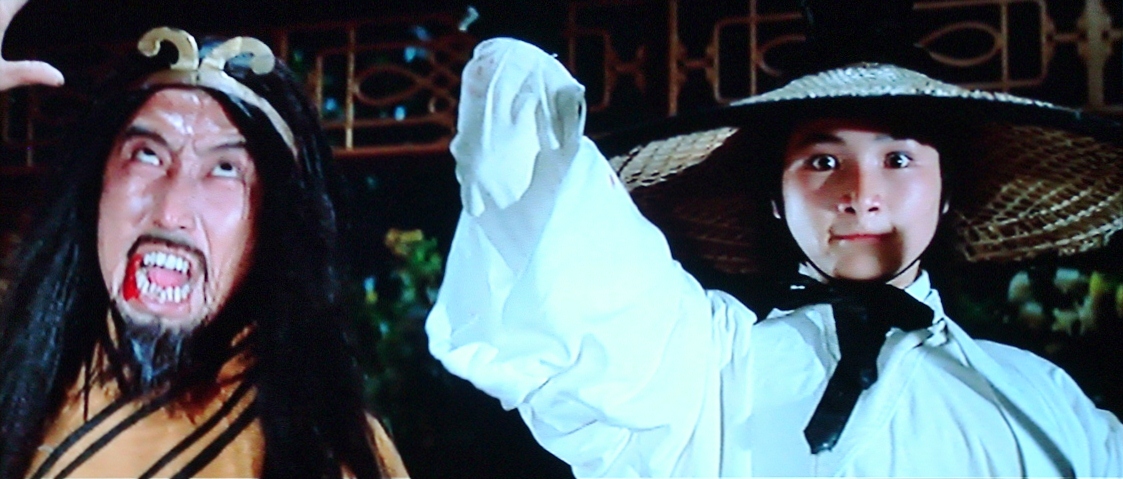
| (All images courtesy Celestial Pictures.) |
FOR all the acting ability she showed in a variety of parts through the twenty-three pictures she did for Shaw Brothers, Cheng Pei-pei is best known for her wuxia movies, or, rather,
one wuxia movie:
Come Drink with Me. While opinions vary over King Hu's film (even its status as a classic), most agree her star turn as Golden Swallow is the model for the character of a strong swordswoman that Hong Kong screenwriters were inspired to copy (if not better) in future wuxias at Shaw and other studios. The way the Shaw experience went down, not one wuxia after
CDwM could duplicate its success, including
Golden Swallow, the sequel directed by Chang Cheh. Even the prescence of Pei-pei in these follow-ups didn't guarantee a good picture, demonstrating how much the arrangement of the young woman under the guidance of director Hu was one of those "blue moon" occurrences.
The Lady Hermit is among those select few Shaw wuxias that came close to the level of quality found in
CDwM. While not as moody or "trippy", after energetic fighting scenes and a "love triangle" subplot,
TLH is best remembered for Pei-pei working with the woman who'd try to replace her as Shaw's wuxia queen, Shih Szu.
Three years prior to the events depicted in
TLH, the sword-wielding heroine known as Lady Hermit (Cheng Pei-pei) disappeared shortly after fighting the self-proclaimed Number One bad ass of the martial arts world, Black Demon (Wang Hsieh), who wounded her in the abdomen with his "Shadowless Claw" technique. As it turns out, Yeng Yushuang (her real name) has spent that time laying low in the town of Dungan, recovering from the injury while working at Da Am Security Service as a maid for Chief Wang (Fang Mien).
Arriving in town one day is Ciu Ping (Shih Szu), a young lady who knows how to handle a whip as well as she can a sword; she has come to visit her uncle Wang as she searches for LH in hopes of getting her as a
sifu. When Ping mentions rumors that LH is in the nearby town of Baijiang, Wang arranges a ride there for her with a shipment driven by Chang-chung (Lo Lieh), a good-looking escort she develops a crush on. Once in Baijiang, she finds out LH is supposedly in Chung Kuei Temple, where the townspeople go to buy charms from her as protection from ghosts that are currently on a nightly murder spree. Ping is skeptical about the whole situation, and not long after she realizes the "ghosts" are flesh and blood, she and Chang-chung enter the temple, discovering this LH is a phony Black Demon is using to lure the real one into a trap. As LH eventually shows up to eliminate the imposter and rescue Ping and Chang-chung, the moment the two hear LH's voice, they realize the mystery woman is Yushuang.


With Yushuang's cover blown, she abruptly leaves the security service; Ping quickly finds her on the road and begs Yushuang to teach her kung fu. United by their common hatred of Black Demon, Yushuang agrees, and as they refurbish an abandoned house for shelter, Yushuang trains Ping, including showing her the "Flying Tiger" style, a countermove to the "Shadowless Claws" where (basically) landing on one's feet like a cat after after being thrown by an opponent may help one to gain the upper hand.

As several weeks pass by, Ping's attraction to Chang-chung has increased since she began teaching him the martial arts she's learned from Yushuang, but what Ping doesn't know is he's had feelings for Yushuang since she was working at the security service. In turn, Yushuang cares just as much for him, but she can't think about romance until she deals with Black Demon. However, when Chang-chung suddenly arrives at the hideout in a mutilated state after barely escaping from Black Demon's men at the security service (because of his ties to LH, they have slain Wang and burned the business to the ground), Yushuang helps him to recover while Ping is away collecting ingredients for some medicine, and in the process, she lets her guard down for him...a little.


When Ping comes back from a month's worth of gathering, she sees the two of them together, and jealousy clouds her mind in a hurry. Twenty-four hours later, her perceptions haven't changed, and on an impulse, she decides to handle the messy affair of killing Black Demon herself. Despite Yushuang's assertion she isn't ready, Ping rushes off to get him anyway. With Yushuang and Chang-chung trailing not too far behind, Ping defies the odds by overcoming all barriers along the way before finally arriving at Black Demon's head-quarters. Bottom line: if Ping can't stop him, can Lady Hermit (lingering injury and all) be there in time to save her and be able to deal with Black Demon on her own?
What immediately stands out about
TLH is the superb cinematography by Lin Kuo Chiang, Li Yu Tang and Tsao Wei Chi. After King Hu's movies, such attention to the slightest of visual details is typical of director Meng-hua's best films, and
TLH is no exception. Every last shot taken seems to have been given some significant thinking through, from the lighting to camera setups. In conjunction with Chang Hsing Lung's marvelous editing, every scene, whether a quiet one or full of swordplay and arterial spray, benefits from the craftsmanship of these talented guys. For the era, this is one of the best looking "old school" wuxias ever.
Yeh I-Fang's screenplay for
TLH wisely reinforces the "less is more" argument with straightforward storytelling without a lot of psychology. (I imagine his version of
Crouching Tiger, Hidden Dragon would be called
"Tiger and Dragon", for a start.) He keeps the action and Black Demon off at strategic intervals in order to focus more on the sisterly bond between Ping and Yushuang, which is only threatened when Chang-chung (innocently) enters the scenario. As sufficiently developed the low-key soap opera is, the looming prescence of Black Demon should've been emphasized more. As it is now, he comes off as just a big bully. Further, if anyone attempted to bring an end to his reign of terror in the past, no previous contenders are mentioned; this implies only LH (Ping comes later) has stood up to him, which is pushing the limits of all plausability. (Possibly, a more physically imposing actor other than Wang Hsieh could've been cast, but this would've solved only half the problem.)

The acting (aside from what Hsieh brings to the production) does not disappoint at any level. Cheng Pei-pei easily gives style and substance to LH, and the well-written part is in synch with her usual good performance, and this wasn't always the case with some of the wuxias she did after
CDwM. Lo Lieh appropriately underplays Chang-chung, the "eye in the hurricane" for the film, whether quietly pining for Yushuang or charming the lovestruck Ping. Among the supporting players, more than a few familiar faces pop up as Black Demon's men; keep watch for Chuan Yuan (
The Thunderbolt Fist), Cliff Lok, Yeung Chak-Lam (
The Shadow Boxer), Kok Lee Yan and Sammo Hung.
Even though it's Pei-pei's movie, the other reason
TLH exists is to showcase Shaw's rising star, Shih Szu, the designated heir apparent to Pei-pei. So it goes she does a lot more in
TLH (her third Shaw picture) than Pei-pei, but to her credit, she doesn't upstage Pei-pei. She portrays Ping as a young woman who shows maturity with a sword and whip but is still immature to many ways of the world and life. The acting range she displays is as impressive as the kinetic fighting action (supervised by Leung Siu Chung) and two sequences of elaborate stuntwork (involving a bridge and a pagoda) she participates in. I also get a kick out of the light moments she shares with Lieh where Ping practically swoons over Chang-chung; whenever the lovely Szu acts bashful and flirty, no fan of hers is immune to her charms (especially Brother Fang).
Funimation's last Shaw DVD release (until we hear otherwise) is consistent with their previous reissues. It has a fine anamorphic picture (stemming from a proper transfer with no "combing" in the playback), and the two soundtrack choices (English and Mandarin audio in their original mono, the latter with optional English subtitles) both sound great. The only "extras" found on the disc are advertising.
Through the May '70 issue of Hong Kong Movie News (thanks to
venoms5 over at Cool Ass Cinema for the info), we know Pei-pei left Shaw to get married, and move to the US to retire from moviemaking, after finishing work on Lo Wei's
The Shadow Whip. Had
TLH been her last film, it would've made her exit from Hong Kong that much sweeter; unfortunately, seven months after
TLH's January '71 opening, Shaw let
TSW drop, an uninspired piece of work in which Pei-pei's character brandished a whip much like Szu did in
TLH. (Hindsight is 20/20, but Shaw would've been better off leaving
TSW in the vault or putting it out before
TLH.) As the business of cranking out motion pictures at Shaw went during the early 1970s, they were staying the course, right down to thoughtlessly giving their departed star one more raw deal.
(Two years later, Golden Harvest would coax Pei-pei out of retirement, but that is a story best saved for another time.)
Brother Fang says... "Fans of Cheng Pei-pei, Lo Lieh and Shih Szu are already sold on this, and all lovers of Shaw Brothers' wuxia films should follow suit. It's a good, affordable DOMESTIC copy of a hard-to-find import; need I say more?"
Keeping it trivial....
Fang Shih-yu, Shaolin Temple.