Powered By Blogger

Tuesday, February 22, 2011

The Lady Hermit (1971), starring Cheng Pei-pei, Shih Szu, Lo Lieh and Wang Hsia. Directed by Ho Meng-hua.

(All images courtesy Celestial Pictures.)

FOR all the acting ability she showed in a variety of parts through the twenty-three pictures she did for Shaw Brothers, Cheng Pei-pei is best known for her wuxia movies, or, rather, one wuxia movie: Come Drink with Me. While opinions vary over King Hu's film (even its status as a classic), most agree her star turn as Golden Swallow is the model for the character of a strong swordswoman that Hong Kong screenwriters were inspired to copy (if not better) in future wuxias at Shaw and other studios. The way the Shaw experience went down, not one wuxia after CDwM could duplicate its success, including Golden Swallow, the sequel directed by Chang Cheh. Even the prescence of Pei-pei in these follow-ups didn't guarantee a good picture, demonstrating how much the arrangement of the young woman under the guidance of director Hu was one of those "blue moon" occurrences.

The Lady Hermit is among those select few Shaw wuxias that came close to the level of quality found in CDwM. While not as moody or "trippy", after energetic fighting scenes and a "love triangle" subplot, TLH is best remembered for Pei-pei working with the woman who'd try to replace her as Shaw's wuxia queen, Shih Szu.

Three years prior to the events depicted in TLH, the sword-wielding heroine known as Lady Hermit (Cheng Pei-pei) disappeared shortly after fighting the self-proclaimed Number One bad ass of the martial arts world, Black Demon (Wang Hsieh), who wounded her in the abdomen with his "Shadowless Claw" technique. As it turns out, Yeng Yushuang (her real name) has spent that time laying low in the town of Dungan, recovering from the injury while working at Da Am Security Service as a maid for Chief Wang (Fang Mien).

Arriving in town one day is Ciu Ping (Shih Szu), a young lady who knows how to handle a whip as well as she can a sword; she has come to visit her uncle Wang as she searches for LH in hopes of getting her as a sifu. When Ping mentions rumors that LH is in the nearby town of Baijiang, Wang arranges a ride there for her with a shipment driven by Chang-chung (Lo Lieh), a good-looking escort she develops a crush on. Once in Baijiang, she finds out LH is supposedly in Chung Kuei Temple, where the townspeople go to buy charms from her as protection from ghosts that are currently on a nightly murder spree. Ping is skeptical about the whole situation, and not long after she realizes the "ghosts" are flesh and blood, she and Chang-chung enter the temple, discovering this LH is a phony Black Demon is using to lure the real one into a trap. As LH eventually shows up to eliminate the imposter and rescue Ping and Chang-chung, the moment the two hear LH's voice, they realize the mystery woman is Yushuang.

With Yushuang's cover blown, she abruptly leaves the security service; Ping quickly finds her on the road and begs Yushuang to teach her kung fu. United by their common hatred of Black Demon, Yushuang agrees, and as they refurbish an abandoned house for shelter, Yushuang trains Ping, including showing her the "Flying Tiger" style, a countermove to the "Shadowless Claws" where (basically) landing on one's feet like a cat after after being thrown by an opponent may help one to gain the upper hand.

As several weeks pass by, Ping's attraction to Chang-chung has increased since she began teaching him the martial arts she's learned from Yushuang, but what Ping doesn't know is he's had feelings for Yushuang since she was working at the security service. In turn, Yushuang cares just as much for him, but she can't think about romance until she deals with Black Demon. However, when Chang-chung suddenly arrives at the hideout in a mutilated state after barely escaping from Black Demon's men at the security service (because of his ties to LH, they have slain Wang and burned the business to the ground), Yushuang helps him to recover while Ping is away collecting ingredients for some medicine, and in the process, she lets her guard down for him...a little.

When Ping comes back from a month's worth of gathering, she sees the two of them together, and jealousy clouds her mind in a hurry. Twenty-four hours later, her perceptions haven't changed, and on an impulse, she decides to handle the messy affair of killing Black Demon herself. Despite Yushuang's assertion she isn't ready, Ping rushes off to get him anyway. With Yushuang and Chang-chung trailing not too far behind, Ping defies the odds by overcoming all barriers along the way before finally arriving at Black Demon's head-quarters. Bottom line: if Ping can't stop him, can Lady Hermit (lingering injury and all) be there in time to save her and be able to deal with Black Demon on her own?
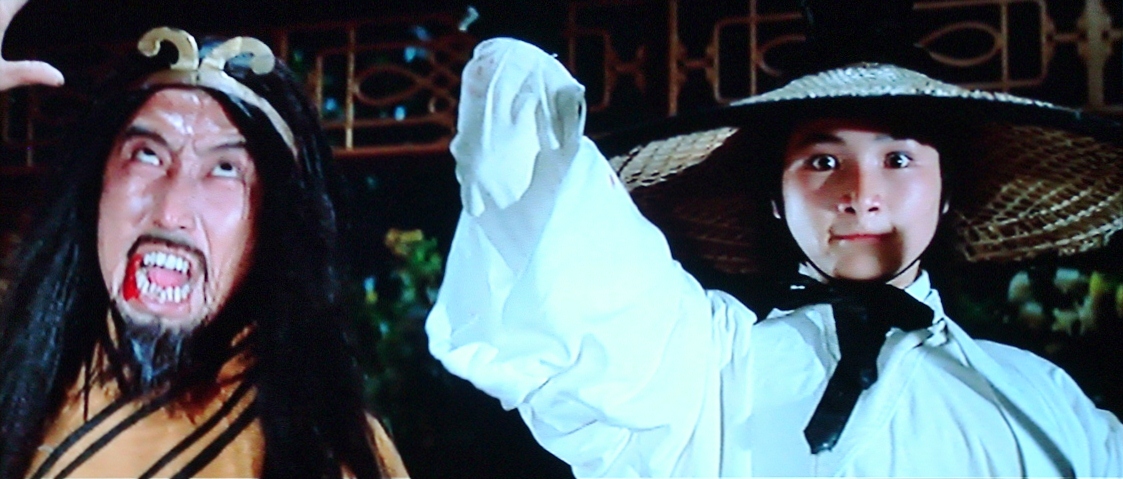

What immediately stands out about TLH is the superb cinematography by Lin Kuo Chiang, Li Yu Tang and Tsao Wei Chi. After King Hu's movies, such attention to the slightest of visual details is typical of director Meng-hua's best films, and TLH is no exception. Every last shot taken seems to have been given some significant thinking through, from the lighting to camera setups. In conjunction with Chang Hsing Lung's marvelous editing, every scene, whether a quiet one or full of swordplay and arterial spray, benefits from the craftsmanship of these talented guys. For the era, this is one of the best looking "old school" wuxias ever.

Yeh I-Fang's screenplay for TLH wisely reinforces the "less is more" argument with straightforward storytelling without a lot of psychology. (I imagine his version of Crouching Tiger, Hidden Dragon would be called "Tiger and Dragon", for a start.) He keeps the action and Black Demon off at strategic intervals in order to focus more on the sisterly bond between Ping and Yushuang, which is only threatened when Chang-chung (innocently) enters the scenario. As sufficiently developed the low-key soap opera is, the looming prescence of Black Demon should've been emphasized more. As it is now, he comes off as just a big bully. Further, if anyone attempted to bring an end to his reign of terror in the past, no previous contenders are mentioned; this implies only LH (Ping comes later) has stood up to him, which is pushing the limits of all plausability. (Possibly, a more physically imposing actor other than Wang Hsieh could've been cast, but this would've solved only half the problem.)

The acting (aside from what Hsieh brings to the production) does not disappoint at any level. Cheng Pei-pei easily gives style and substance to LH, and the well-written part is in synch with her usual good performance, and this wasn't always the case with some of the wuxias she did after CDwM. Lo Lieh appropriately underplays Chang-chung, the "eye in the hurricane" for the film, whether quietly pining for Yushuang or charming the lovestruck Ping. Among the supporting players, more than a few familiar faces pop up as Black Demon's men; keep watch for Chuan Yuan (The Thunderbolt Fist), Cliff Lok, Yeung Chak-Lam (The Shadow Boxer), Kok Lee Yan and Sammo Hung.

Even though it's Pei-pei's movie, the other reason TLH exists is to showcase Shaw's rising star, Shih Szu, the designated heir apparent to Pei-pei. So it goes she does a lot more in TLH (her third Shaw picture) than Pei-pei, but to her credit, she doesn't upstage Pei-pei. She portrays Ping as a young woman who shows maturity with a sword and whip but is still immature to many ways of the world and life. The acting range she displays is as impressive as the kinetic fighting action (supervised by Leung Siu Chung) and two sequences of elaborate stuntwork (involving a bridge and a pagoda) she participates in. I also get a kick out of the light moments she shares with Lieh where Ping practically swoons over Chang-chung; whenever the lovely Szu acts bashful and flirty, no fan of hers is immune to her charms (especially Brother Fang).

Funimation's last Shaw DVD release (until we hear otherwise) is consistent with their previous reissues. It has a fine anamorphic picture (stemming from a proper transfer with no "combing" in the playback), and the two soundtrack choices (English and Mandarin audio in their original mono, the latter with optional English subtitles) both sound great. The only "extras" found on the disc are advertising.


Through the May '70 issue of Hong Kong Movie News (thanks to venoms5 over at Cool Ass Cinema for the info), we know Pei-pei left Shaw to get married, and move to the US to retire from moviemaking, after finishing work on Lo Wei's The Shadow Whip. Had TLH been her last film, it would've made her exit from Hong Kong that much sweeter; unfortunately, seven months after TLH's January '71 opening, Shaw let TSW drop, an uninspired piece of work in which Pei-pei's character brandished a whip much like Szu did in TLH. (Hindsight is 20/20, but Shaw would've been better off leaving TSW in the vault or putting it out before TLH.) As the business of cranking out motion pictures at Shaw went during the early 1970s, they were staying the course, right down to thoughtlessly giving their departed star one more raw deal.

(Two years later, Golden Harvest would coax Pei-pei out of retirement, but that is a story best saved for another time.)

Brother Fang says... "Fans of Cheng Pei-pei, Lo Lieh and Shih Szu are already sold on this, and all lovers of Shaw Brothers' wuxia films should follow suit. It's a good, affordable DOMESTIC copy of a hard-to-find import; need I say more?"

Keeping it trivial....

Fang Shih-yu, Shaolin Temple.


Thursday, February 10, 2011

Brother Fang's Second Special Note: Your eyes weren't deceiving you....

(Image courtesy GSN.)

BACK in late January, a third entry in the Get Ready to Forget the "Match Game" Stars! series was up, if ever so briefly. Though this posting was essentially completed when published, in the days that followed its publication, I decided to withdraw it to do some drastic revisions. For me, it wasn't so much the content that bothered me as it was the writing angle with which I approached it. Since the post in question (a profile of actor Joe Flynn) is a lighter piece, I'm in no hurry to repost it any time soon, but it will reappear sometime in the future. (Additional Match Game profiles are in the works; keep a watch for them in the weeks and months ahead.)

So, to anyone who recalls seeing this listed on the Dashboard weeks back, and wondered where it disappeared to, your eyes weren't deceiving you; it was out, and now, it's not. I'm sorry for any confusion that may have resulted from this deletion.

Keeping it trivial....

Fang Shih-yu, Shaolin Temple.

The Delinquent (1973), starring Wong Chung, Lo Dik and Lily Li. Directed by Chang Cheh and Kuei Cheh-hung.

(All images courtesy Celestial Pictures.)

IF Friends can be categorized as a fairy tale (a little Grimm, by some measure), then The Delinquent is pure tragedy. This could be said about more than a few of director Chang Cheh's better-known Shaw Brothers movies (like The Assassin or The Heroic Ones), but The Delinquent towers over them all with its unique, increasingly morose tone. Out of all Cheh's attempts to emulate the angst of the "Reckless Youth" found in Rebel Without a Cause (1955), he succeeds here --exceeds, really-- the best. (James Dean's "Jimmy Stark" in RWaC wouldn't last five minutes in this bleak Hong Kong.) However, he wouldn't have created this triumph without the help of three key people: writer Ni Kuang, co-director Kuei Cheh-hung and actor Wong Chung (in his first leading role).

As the plot generally goes, the teenaged John (Wong Chung) convinces himself the easiest, quickest way he and his father (Lo Dik) can get out of living and working in the HK slums is if he helps Boss Lam (Tung Lin) and his gang of robbers get into Wing Kee Warehouse to clean it out, after which John will be given a generous portion of the profits for his assistance. What complicates matters is his father is the head night-watchman at the warehouse.

While we don't know all of John's backstory, we can guess things started getting tough when his mother (seen in a brief flashback) left home. Apparently, she tired of being a housewife at some point and started going out evenings; his father thought slapping her around would bring her back to reality. It did; she divorced him and married an understanding butcher (Shum Lo). Her subsequent attempts to communicate with John through messages delivered to him by his girlfriend, Elaine (Lily Li), only serve to anger him.

The script rationalizes the father's boorishness to his being head of the household and his reputation around the area for being rough on would-be crooks who've previously tried to break into the warehouse. He wants John to get ahead in the world through hard work and avoiding shortcuts to prosperity. Though John loves his father, he sees the results of all the old man's laboring as a big waste, because it seems he hasn't advanced any further than those who also find time to relax and raise hell once in a while. These days, John is taking after more like his mother, so his father can't help but worry.

Sometime after he's fired from his job at a restaurant for fighting on the streets too much (which always brought the cops to the establishment, to the detriment of their business), John gets word of how Boss Lam needs him so they can infiltrate the warehouse. Lam's underling, Big Sean (Fan Mei Sheng), oversees a brothel, and he offers a woman to John as a means to win him over. Even after a night with her, John can't commit to the deal; when Big Sean then demands immediate payment for sleeping with the lady, John only offers to pay him later. In short order, Big Sean and some of Lam's other men track him down at a beach and beat him up when he decides not to pay at all.

Shortly, John is picked up by the police, and when his father refuses to post bail for him this time, it's Boss Lam who sets him free. Lam now talks directly with John about the proposition, offering him (in addition to money) employment, new clothes, a sports car and time with his girlfriend, Fanny (Pei Ti). It appears Lam doesn't want to mess with John's dad when he suggests to John if he can make his father take time off from work, nothing would happen to him once the caper goes down. John finally agrees to the scheme, and after a reconciliation with him, he persuades his father to take a two-day vacation.

Come the night of the robbery, when John finds out his father is filling in for the now-sick substitute, he quickly finds Lam and his men at a sawmill, telling them to postpone the operation. Of course, he finds out all too soon the deal's off; he's beaten up (again) and is left to have a deadly encounter with a buzzsaw. While John is occupied with escaping from his predicament, Lam and his men rob the warehouse, and in spite of his heroic efforts to stop them, John's father is killed. Upon finding out what all has transpired, John rapidly becomes a revenge-fueled killing machine, taking down Lam's associates one by one before finally confronting Lam himself.


With The Delinquent (released in the US as Street Gangs of Hong Kong), Kuang soloed on the script, writing a sad character study with a strong dose of violence that is always to be expected from a Cheh movie. (Had he done this as a collaboration with Cheh, I'm certain the emphasis would've been more on action.) Limited characterization behind the three lead parts hampers our empathizing with them, to a degree; John is adequately defined, his father has hints of complexity, but Elaine serves no real purpose beyond being rescued by John a couple of times or being an intermediary for him and his mom. (Lily Li gives a good performance, anyway.) Going past these minor problems, Kuang has crafted a cautionary tale where the moral is delivered like a sledgehammer between the eyes.

The original HK trailer for TD (included on the IVL DVD) promised audiences a "NEW KIND OF PRODUCTION" about "THE WRATH OF YOUTH EXPLODING LIKE A VOLCANO" that "WILL MOVIE (sic) YOU......AND EXCITE YOU!" and co-directors Cheh and Cheh-hung gave the people what they wanted. As for their joint effort on TD, it's commonly assumed the directing duties were divided, with Cheh-hung overseeing the dramatic, documentary-like scenes and Cheh handling the ones heavy on action (and his trademark "zoom" shots, though they're actually well-placed here). However, if we know anything of their filmographies, we see both were capable of versatility; based on this, it's more likely Cheh did most of the latter while Cheh-hung did most of the former. It's also possible Cheh saw something particular in Cheh-hung's own films that made him the choice for co-directing TD, because if Cheh had the likes of Wu Ma or Pao Hsueh-li on duty for this, we would not have had the level of emotional drama the movie has. Further, I think the two fed off the creative energies of each other, which is why their styles combine favorably in the completed picture, and TD ranks up there with their most analyzed films.

One of the "regulars" in Cheh movies of the late '60s through the early '70s, Wong Chung practically stepped out of obscurity to his first starring part. Whether TD was written for him or not, and considering all he's given to do during the feature (he's onscreen most of the time), it's gratifying to see the confidence the filmmakers had in letting Chung carry the bulk of the movie. He excels as John, portraying a likeable teenager with a chip on his shoulder who wants the world, and he wants it now. He makes a habit of following the impulses of youth without considering the consequences, from fighting anybody who teases him to jumping at the chance to have sex with a woman (when his girlfriend is saving herself until marriage). Only when he lets himself get involved with Boss Lam, he gets in over his head, with his father caught in the middle. He redeems himself by avenging his father's death in a burst of (volcanic) fury.


It is that very violence (along with the sexual content) which earned TD its (HK) Category "2B" rating (an "R" in the US). All of the film's fight choreography by Lau Kar Leung and Tong Gaai is above average, but it's the 12-minute finale that always gets discussed. The nonstop barrage of brutality and death as distributed by John, culminating in one of the most darkest endings in any Shaw production, is stunning to behold. (It still chills me to the bone after multiple views.) This climax alone should've made Chung another big Shaw star, but he would eventually be overshadowed (in director Cheh's eyes) by his next co-star, Fu Sheng (in Police Force), leaving him to nearly fade into the background before he took up directing his own movies. (What his career would've been like if Fu Sheng never arrived on the scene, I can't guess.)

Seen today, The Delinquent isn't as slick as today's HK flicks, but it still works, though anyone who craves action over melodrama may squirm during the downbeat material as they wait for the next fight scene. With a look of impressive authenticity due to extensive location filming, the film's depiction of a life in the slums, where the people settle for just "getting ahead", says much about their living situation; not once are words like "college" or "job training" ever brought up in the entire 101 minutes. If John didn't know he had other options, or if he did, and he never found the incentive to break away from the cycle of poverty, then that's the greatest tragedy of all.

Brother Fang says..."A worthwhile buy for fans of Chang Cheh, the underrated Kuei Cheh-hung and the criminally-ignored Wong Chung! For the uncertain, try it out by borrowing or renting! Remember, with the volume of mature content in this, do NOT play it with children or overly sensitive people around!"

Keeping it trivial....

Fang Shih-yu, Shaolin Temple.

P.S. - While you still can, purchase it from PlayAsia by clicking here.

Tuesday, January 18, 2011

Friends (1974), starring David Chiang, Fu Sheng, Lily Li and Frankie Wei. Directed by Chang Cheh.

(All images courtesy Celestial Pictures.)

IF you combine Rebel Without a Cause with The Bowery Boys, add a dash of Poor Little Rich Girl (in this story, a rich young man), and filter it through director Chang Cheh's "yang gang", the result wiil be Friends. It's the last Shaw Brothers movie Cheh would make in the "younger generation"-oriented vein, as his main focus shifted to the making of the "Shaolin" pictures. Though it was one of those very films (Heroes Two) that introduced HK moviegoers to new star Fu Sheng in early 1974, Friends was actually the first one (with him in a lead role) completed. Its release would be held up until the summer, and while it's only a good guess it did OK box office, what can be confirmed is the "Best Young Newcomer Award" the movie won at the '74 Asian Film Festival. The recipient: Fu Sheng.

After a prologue where we find the title characters have gathered for a reunion, their backstory (the rest of the film) is related as a flashback. Going back to ten years ago, there are just the nine of them (give or take), a bunch of twenty-somethings living a lower-class existence of doing menial jobs by day and raising hell at night; all of them desire to advance their standing in the world and live a better life. The bond of friendship manages to see them through bad times and good. The guys are also fortunate to find the spare time they can to keep their kung fu skills up to snuff, because they're necessary in a big city like HK.

Their unofficial leader is Hua Heng (David Chiang), an advertising sign painter who aspires to become a famous artist. His girlfriend is Gao Xin (Lily Li), a bargirl who might get forced into prostitution by the loan sharks she owes money to if she doesn't pay off her debt of $20,000 [HK].

Into their lives arrives Tu Jiaji (Fu Sheng), the only child of the wealthy Tu Dongtai (Lo Dik). Practicing martial arts only does so much for him; he's unhappy and bored living a sheltered life. One day, when he jumps in to help Heng fight off some street thugs, he's excited to meet someone closer to his age who's cool and can take care of himself. In turn, Jiaji (like a neglected puppy craving attention) trails after Heng to an abandoned warehouse, inadvertently introducing himself to Heng's other friends when he crashes through a sky window above their makeshift gymnasium in the basement.

It doesn't take long for Heng and the others to warm up to Jiaji; they think he's down on his luck like they are. Indeed, when he innocently asks why don't they work out at a "better gym," they think he's kidding around, and they nickname him "Young Master". With this new name, he doesn't bother bringing up his real one. He's also in no rush to go home, so he calls his dad, saying he's spending a few days with some "future" capitalists and not to worry. Concerned as Dontai is, he convinces himself Jiaji's all right and leaves him be.

Once Jiaji hears of Xin's money problems, he's resolved to get her out of trouble with help from another of his new friends, Lin Sibao (Lee Yung-git). While Jiaji pretends to sell some of Heng's paintings, he actually has Sibao get the money from his father (being sure not to mention he is Dongtai's son), using a ring of his (personally given to him by his father) as a means to getting the cash without a hassle. Of course, the instant Dongtai recognizes the ring, combined with the asking for money, he thinks Jiaji's been kidnapped, and he readily gives Sibao the full amount. For all the madness behind Jiaji's method (also driving his father mad), Xin's dilemna is resolved, and Heng comes off like a hero in the process.

Unfortunately, the recently unemployed Sibao is hurting for money, and in an act of weakness, he uses the ring again to extort more money from Dongtai. Worse, he's an acquaintance of the loan sharks, and when he flashes his new wealth in front of them, they can't help but wonder how he got rich all of a sudden. When Sibao tells them, showing them the ring, they realize the "Young Master" is the son of Dongtai, thanks to a newspaper ad he put out in hopes of communicating with the (then non-existent) kidnappers. Under orders from their boss (Frankie Wei), they kidnap Jiaji for real... with assistance from Sibao!

Once Sibao finds out Jiaji will be killed upon the collecting of the ransom (a triple dip into Dongtai's wallet), he finally sees the error of his ways, and he runs off to tell Heng what has occurred. Heng has since found out what Jiaji did for Xin, so once Sibao fills him in on the details of who Jiaji is and his current plight, he makes a frantic dash to rescue Jiaji from his captors, while Xin and Sibao round up the remaining friends for extra support in a race against time.


The most common complaint about Friends centers on how David Chiang and Fu Sheng interact as the leads. Some sense a lack of dynamics between them, which doesn't ring true with the assertion they are supposed to be friends. People forget that Jiaji and Heng get introduced to each other under tense circumstances, and Jiaji doesn't help matters when he ruins Heng's portrait of Xin by smashing it over his chauffeur's head! Further, Heng's trying to break out as an artist while juggling a girlfriend and a job at the same time. For all the friends he has now, the sudden surfacing of Jiaji (who appears to have no friends at the beginning of the film, except his sifu Wang, played by Tung Choi-bo) seems to be one friend too many for him to handle. Once Jiaji gets to meet Heng's other friends, any burden is lifted off his shoulders and distributed to everyone else; only then does he begin to see Jiaji's a nice guy. Significantly, what we are observing is the beginnning of a friendship over the few days' time covered in the film, and by having seen the prologue, we know it will still be thriving ten years later (and counting). As the start of friendships go, Chiang's performance rings true, and it compliments the one delivered by Sheng.

Allowing for the usual Shaw script deficien-cies, the screenplay by Cheh and Ni Kuang is pretty good, but more character development would've been beneficial to the story. (Among the precious few pearls we're given, Bruce Tong's vignette where he dreamily ogles women while working at a pool hall is very funny.) As this is a Cheh movie, we're lucky to have what characterization there is, and while there's more violence here than in Young People, also like that film, nobody dies, so we should appreciate any restraint Cheh decided to use. Even so, our "suspension of disbelief" is tested by how Jiaji gets the money to pay off the loan sharks and what leads to his being abducted. Most importantly, if this happened in the real world, Sibao would wind up in prison for being an accessory to kidnapping!

If you don't dig too deep into it, the movie works well within its low budget, from the photography by Miyaki Yukio (a.k.a. Kung Mu To) to the bone-crunching kung fu co-ordinated by action directors Lau Kar Leung and Tong Gaai. The casting works from the leading roles (though Lily Li is underused) to the supporting players. (As noted previously, the late Chen Wo-fu has a few moments here as Jin Bing-da, a mechanic; hindsight or not, his unique prescence is compelling enough you wish he had a bigger part.)


Out of all the pictures Cheh made, Friends qualifies as his top "sleeper". One look at it, and you'll understand why other Shaw fans pass this up in favor of his bloodiest classics. It's as close as he ever got to doing a "little" film, and at the same time, he conveys his recurring themes of brotherhood and "yang gang" in the most accessible way better than he ever did in his biggest epics. He takes his discovery Fu Sheng and gives him a modest showcase in which to display his bubbling talents. Sheng is up to this early challenge, bringing Jiaji to life as an engaging person. He's rough around the edges with respect to his acting and fighting skills, but any noticeable lapses are smoothed over with his winning personality and (especially for the ladies) sex appeal. Anybody who likes Chang Cheh, Fu Sheng or wanting a break from the "average" Shaw martial arts movie needs to buy (or rent) this.

Brother Fang says..."Fu Sheng fans: BUY this! Everyone else: Give it a test run (rent or borrow one) before investing in a copy!"

Keeping it trivial....

Fang Shih-yu, Shaolin Temple.

P.S. - Purchase it from DDDHouse by clicking here.

Tuesday, January 4, 2011

The Shadow Boxer (1974), starring Chen Wo-fu, Shih Szu and Frankie Wei. Directed by Pao Hsueh-li.


ON January 1, 1974, Chen Wo-fu killed himself on his 24th birthday. Why he did is yet unknown thirty-seven years after the fact. Since what biography there is of him is limited in scope (for those fluent only in English), any speculation the reason he did it because he was unhappy with his personal life or with making motion pictures is pointless. It's safe to say his act was one of a desperate person crying out in pain, but if he was hoping to be saved, only a "higher authority" knows for sure.

 Cheng Tien-Hsuing, Tai chi co-ordinator for the
movie, does a demonstration with Chen Wo-fu.
He had joined Shaw Brothers a mere two years prior, and of the five films he had worked on before his passing, The Shadow Boxer would not only be the first one to get released, it would be the sole one where he had the starring role. It was also unique by virtue of its subject matter; coming out two months after the movie showcase of Hung Fist martial arts in Heroes Two (1974), TSB spotlighted the rarely seen form of Tai chi chuan (a.k.a. shadow boxing, which is from where the film gets its title). Wo-fu knew it inside and out (in addition to having won the title of SE Asian Chinese Boxing Champ in 1971), and it's possible TSB was written for him. Even if it wasn't, writer Ni Kuang, by adhering to many of the basics of Tai chi and the philosophy behind it, crafted a piece of "old school" HK action cinema like no other.

It's sometime in the 1930's, and when the laborers of a road construction crew are forced to roast in the hot summer sun while waiting to collect their lousy monthly wages, worker Wu Bing Lien (Chung Gam Gwai) raises a protest as their de facto representative. This is fine for crooked supervisor Tang Hoi Hay (Yeung Chak-Lam), who'll use any excuse to screw them out of their pay (after taking half for himself) for his employer, Master Jin (Cheng Miu); when he tries to punish Wu for striking him, Wu's friend Ku Ding (Chen Wo-fu) takes the beating for him as a way to keep the situation from becoming chaotic.

His rationale for doing this is because he's been a student of Tai chi for ten years under his sifu Yeung (Yeung Chi Hing); the general idea is for him to "practice martial arts for health and defence, not for bullying others", and he "has to be tolerant". As far as Yeung's daughter, Ah Jen (Shih Szu), is concerned, she's not sold on this and feels Ku is a sap for being smacked around without retaliating. She's content to use only the basic martial arts she's skilled in.

Times are so tough in the town where the workers live, people are desperate to get money anyway they can, so Ku's sweetheart, Ah Bao (Chan Mei Hua), seeks employment at the house of Jin's son, Dai Sing (Frankie Wei), as a servant for his girlfriend. He's a bastard who enjoys all the benefits of his father's dirty money and standing in society. One day, after another boring sparring session with some of his associates, one of them, the be-sotted Chan Tung (Wong Kuong Yue), tells him his kung fu would definitely be tested if he dealt with sifu Yeung's Tai chi. Dai's interested; he sends the four men off to bring Yeung back and challenge him. Yeung declines the invitation, so the spoiled brat orders them to kill the old man.

In the meantime, Wu is still championing his fellow worker's rights (as is Ku Ding, in a more mannered way), and Supervisor Tang feels he's stirred enough trouble that he must be gotten rid of; with Dai's blessing, he hires thugs to murder him.

As for Ah Bao, Dai's been ogling her from day one, and once the moment arrives she's alone and vulnerable, he wantonly ravishes her in the ugliest scene of the whole film. Traumatized, she commits suicide by drowning herself in a river.

"Tolerate."
As each ghastly death comes to light, the weight grows heavier on Ku's shoulders to exercise the option of revenge; initially, he keeps to his Tai chi training of tolerance as he needs to be sure of Dai's responsibility for all of it; an attempt to make Dai confess only gets Ku roughed up, but his training enables him to endure the blows Dai and his men bring upon him. Ah Jen is (justifiably) too full of anger to wait for help from Ku, so she plots to stab Dai one morning. The night before, as luck would have it, when Ku goes off to drown his sorrows over these three losses, he gains as a drinking buddy Chan Tung, who eventually helps to confirm for Ku the guilt of Dai. With this knowledge, Ku now is free to help Ah Jen to properly deal with the privileged scum Dai, Supervisor Tang, and the assorted henchmen.


With TSB, writer Kuang mirrors the Three Styles of Hung Fist featurette that got released before Heroes Two (also shown before the feature in early engagements) and begins the movie with a demonstration by Cheng Tien-Hsuing, who choreographed the Tai chi action; along with a sampling of the techniques, plus the aesthetics behind the training throughout the feature, we get a decent overview of Tai chi and what makes it stand out from other martial arts.

The expertise of Tien-Hsuing helps sell the proceedings notably with the time he spent with Shaw character actor Yeung Chi Hing; his effort on the physical aspect in conjunction with Chi Hing's impeccable acting makes the part of sifu Yeung fully realized. The elderly man with the pock-marked face who interacts with Wo-fu and Szu looks more like what we think a master of Tai chi should look like than the sweaty, stout man at the film's beginning!


As director Pao Hsueh-li once did cinematography for Chang Cheh, we're given an approximation of what TSB would be like if Cheh had directed it, but more than that, he adds his eye as a former cameraman to the visual experience. Yeung Teng Bong is behind the camera here, but Hsueh-li brings a lot of the style he brought to Cheh's movies. He keeps the somber thread running through the film with little relief, the roadworkers in the heat looking miserable, Dai's raping feeling like the dirty, despicable act it is, and the murderers killing in a relentless, callous fashion; only in the Tai chi training sequences is there some peace, dashes of slow motion used to catch some of the movements, all accompanied with appropiate music cues.


As the villainy goes, they are all of the "one note" variety, but the most sour note of them all is Frankie Wei. (Yeung Chak-Lam is a worthy second.) When he smiles, it's never for a nice reason, and it has the same impact on me fingernails being dragged across a chalkboard does. As Dai, he plays a even more repulsive type than his roles in some Shaw exploitation pictures, which makes this statement the highest of compliments to his craft! As leader of the bad guys, he pulls off the "regular" (non-Tai chi) fight choreography by Yeun Woo-ping very well for an actor, too. His last confrontation with Wo-fu makes for a suitably apt ending.


In keeping with a story where the combat is earthbound, Shih Szu doesn't come on like the upstoppable hurricane she was in The Thunderbolt Fist, but she manages to hold her own in what feels more like life-or-death situations than in the previous movie. She gets the one funny scene in the whole production where the lovely Ah Jen gets thrown like a sack of potatoes by her father when she shows skepticism over the practicality of Tai chi; only when Ku Ding rescues her from Dai Sing near the end does she finally begin to realize kung fu isn't the only game in town. As always, she's also agile in the dramatics department, and her reaction over her father's slaying grabs at your heart. Her naturalistic work on this picture can be all too easily overlooked by the flash and color of the wuxia films she did, and this movie needs to rediscovered by more of her fans.


As Ku Ding, Chen Wo-fu is likeable and has charisma to spare, which makes his abrupt exit from the world all the more saddening because TSB convincingly conveys the "spark" behind this gifted athlete and budding actor. (For all their brevity, his bit roles in posthumous releases like Friends and All Men are Brothers confirm his work in TSB was no fluke.) Knowing Tai chi certainly helped him get the job; he was fortunate nobody considered taking another Shaw player and teaching them some basics, because more than a few actors could've done this part. (What those results would've been, I cannot guess, which suits me fine.)


Going beyond the off-screen tragedy, TSB is a very watchable diversion in which the plot is the "ying" to Tai chi's "yang". The fact Tai chi never figured again in other Shaws makes it a special novelty worth looking at, whether you know anything about Tai chi or not. Most of all, watch out for the ending, one of the better surprises I've seen in a long time; regardless if you can predict what happens or not, you'll (at least) agree it's... different.

The Image DVD has adequate picture, audio and your choice of English or Spanish subtitles; there are no noteworthy "extras". (I haven't seen the IVL DVD, but I'll bet the picture on it is superior.)

In the end, let this reissue stand as the best Chen Wo-fu testimonial to what might have been. May he continue resting in peace.

Recommended by Brother Fang!

Keeping it trivial....

Fang Shih-yu, Shaolin Temple

P.S. - Purchase it from PlayAsia by clicking here.