Powered By Blogger

Wednesday, October 20, 2010

The Thunderbolt Fist (1972), starring Shih Szu, Chuan Yuan and Nan Kung-hsun. Directed by Chang Yi-hu.

(All images courtesy Celestial Pictures.)
OFFBEAT casting, a plot with a measure of actual details and one of the more unusual endings found in any martial arts movie lifts The Thunderbolt Fist a notch above the "usual" Shaw Brothers product. Make no mistake, this is as derivative as these flicks can get, but most of the good films in any given genre are not innovators. (This picture owes its existence mainly to earlier Shaws like One-Armed Swordsman, The Chinese Boxer and King Boxer.)

Considering the initial reason I got this DVD was only because one of the background players was Fu Sheng (briefly visible in two scenes), I give credit to the star turn of Shih Szu for making me come back for repeated visits. Though her part is in a supporting capacity, she has top billing; it's her picture to steal, and she does it well.

Brother Fang reminds you Shih Szu is HOT!

A sizeable band of Japanese ronin invade a town in northeastern China, terrorizing the citizens into submission and siezing control over the local ginseng trade; people can sell it only to the Japanese. When a group of farmers led by Gin Chi (Gam Kei Chu) resist this, they rough it up with some of the ronin, killing one. With the elders of the town (including the mayor) afraid to take any action against the Japanese, Gin and his friends make their escape to the mountains, vowing to take care of the ronin themselves after a period of extensive training.

The ronin are so itching to show their superiority to the Chinese, they've even built a fighting ring in the town upon which they intend to make spectacles of the "sick men of Asia". Before leaving, Gin Chi suggests if Ping Bai (Feng Mien) of the Jinxian School of martial arts defeats the ronin leader, Gu Lan (Chan Feng Chen), in the ring, they may get rid of the Japanese for good. Gu himself delivers this challenge to Ping, and they eventually have at it; despite some injury to himself, Ping defeats Gu, killing him.

Chan Feng Chen and Feng Mien.

The ronin go after Ping, killing him in retalation; Ping's friend, Old Wang (Wong Ching Ho), flees with Ping's son, Tie Wa, to the mountains where Gin Chi is hiding out. In their haste, they leave behind Ping's manual on the "Thunderbolt Fist" technique in the care of Tie's childhood sweetheart, Feng Niou.

Shih Szu and Chuan Yuan.

Ten years later, the kung fu of the older Tie Wa (Chuan Yuan) is pretty good, thanks to his being trained by Gin and his daughter, Die Er (Shih Szu), but it's now time for Tie to retrieve the manual, the book that holds the key to getting the ronin out of their lives. He departs for town to find Feng Niou (Wong Chin Feng) and guage how tough the ronin forces are.

Wong Chin Feng and Chuan Yuan.

Tie finds out Feng has married his old friend Da Xiong (Tung Lin), who rescued her from the clutches of Gu Gang (Nan Kung-hsun), the son of Gu Lan who now leads the ronin. (By catching a glimpse of him in action, Tie knows Gu's martial arts skills are even better than that of his father's.) Gu Gang, having dealt with Tie and Da when they were all younger, knows these two working together will bring him unwanted hassles; he has innuendo spread around town that Tie has been fooling around with Feng. Soon enough, Da tries to mix it up with Tie over the misunderstanding, but Feng intervenes, telling them it's a ploy by the Japanese to turn them against each other. A battered Tie wisely retreats, taking the manual with him.

Having barely started to learn the Thunderbolt Fist, Tie impulsively sets off to town again to deal with Gu, staying under wraps at the closed-up Jinxian school. Against Tie's wishes, Die Er sneaks off after him, arriving to see firsthand how the townspeople are getting shaken down by the ronin, including having to pay protection money. Figuring out where Gu resides, she sneaks in at night, steals a large quantity of currency from his vault, and redistributes it to the people who need it more.

Upon discovery of the theft, the ronin think Tie is the one responsible for it, and Gu sends off a challenge to Tie to meet him at the ring for a duel. Da Xioung intercepts the note, and having realized his misjudgement in accusing Tie of adultery, goes to fight Gu in his place in hopes of making up for his mistake. Gu fatally wounds Da, and he's left to slowly die.

Wong Chin Feng and Nan Kung-hsun.

Once Gu discovers where Tie's been hiding in town, he goes off with some men after him. Tie has yet to be a match for Gu, and he gets captured, as is Feng not long after her husband passes on. Tie is tortured by the ronin, the worst of it being a disabling of his right arm while a horrified Feng watches on. Only her agreement to submit herself to Gu's sexual appetite saves Tie from death, and he gets released. After Tie is gone into the night, Feng commits suicide before Gu can lay a hand on her.

As Tie recovers back at the mountain hideaway, he hears of Feng's ultimate sacrifice, reinforcing his determination to resume learning from the manual, despite his recent handicap. With one good arm and two legs, it's not long before he masters the technique, and he and all the other Chinese patriots finally ride into town, ready to take on the Japanese. Many ronin get slaughtered in a long, bloody struggle, and Tie manages well against Gu, much to Gu's amazement. He brings the battle to an abrupt stop, saying he and Tie should finish the fight the next day in the fighting ring; Tie agrees.

Gu uses one last dirty ploy to better his odds; he has a man try to slash one of Tie's legs hours before the bout. Even that's not enough to deter Tie, and come the morning, he goes to face off with Gu, hoping to bring an end to the ronin's hold over the town by bringing down their leader in the same ring where his father stopped Gu's father years ago....

After that...NO "SPOILERS"!

A cut scene from The Thunderbolt Fist.
(Nan King-hsun and Gan Kei Chu.)

As the story goes, scriptwriter Li Cho Chien throws in some specifics not always found in "revenge" pictures. Tie Wa, Feng Niou, Da Xiong and Gu Gang knew each other in childhood, as illustrated by the opening scenes and a flashback; their interactions with each other have a payoff (most of them not nice), which helps us to empathize with the good guys. (This extends to Tie Wa's initial training with Die Er, though the fact the girl playing a younger version of Shih Szu doesn't have the closest resemblance to her is a slight fault.) The rest of the "Chinese versus Japanese" storyline goes into Fist of Fury territory, but along with an air of Chinese patriotism, the final confrontation with the ronin is more believable as the hopes of all the Chinese doesn't rest on one person's shoulders.

This was South Korean director Chang Yi-hu's first film for Shaw; circumstantial evidence suggests he may have had some sort of assistance from Jeong Chang Hwa, director of King Boxer. Yi-hu could've been facing a language barrier (surrounded by people who spoke only Mandarin) during the making of TTF, so a fellow South Korean (who dealt with same when he started at Shaw) was brought in to help out! This could explain why more than a few personnel from both sides of the camera in KB are also found in TTF. Compare the credits to both movies at Hong Kong Cinemagic, then watch them both back to back (look at KB first), and you may see what Brother Fang does.

Chuan Yuan, best known for his role as the main heavy in the Chang Cheh movie The Duel, is effectively cast against type as Tie Wa. Some think he looks a lot older than Shih Szu; his facial hair and some of the lighting seems to emphasize this, but the chemistry he and Shih Szu have between one another more than compensates for any inconsistency. He does well in fighting, using two arms or one; he even gets a few unexpected, funny moments in a action scene (in fact, the light tone pops up in other fights) I never anticipated. He's an underrated actor who should've done more movies.

Nan Kung-hsun (who lost his eyeballs in KB) simply oozes nastiness as Gu Gang; he's as ruthless in his fighting as he is in under-handed tactics! As playing it in a one-dimensional sense goes, he's so deserving of having any of his blood spilt!

I do not exaggerate when I say Shih Szu enhances every moment she's on the screen. (No bias here, really; it's the first action role of hers I saw which sold me on this talented woman.) Her part is more lighter in nature than her turn in The Young Avenger, and she handles the martial arts (choreographed by Leung Siu Chung) with the same ease she brings to using swords. By comparison, she's no Angela Mao, but her performance is cute, dramatic and energetic when it needs to be. This is a necessary purchase for all Shih Szu fans, no arguments about it!

The remainder of the cast is just as good, with Fang Mien, Tung Lin and Gan Kei Chu (with a silly wig that makes him look like Rob Reiner as Mike Stivic, the "Meathead") notable standouts. In addition to Fu Sheng, look for cameos by Sammo Hung, Ricky Hui and Bruce Lee's pal Unicorn Chan.

This movie is available on DVD in two versions. The IVL disc is notable for having only the original Mandarin soundtrack as an audio option, plus within the stills gallery is a photo (see above) of a sequence left out of the final edit. (It must take place prior to the last meeting of Tie Wa and Gu Gang, based on what Nan Kung-hsun is wearing.) The anamorphic picture on the Image disc is not as sharp as it is on the IVL, but the US release does have the English dub, which is delirious fun. Whatever version you prefer to get, you will be entertained!

Nothing overly deep here, just pure, non-PC fun.

And that ENDING!

Recommended by Brother Fang!

Keeping it trivial....

Fang Shih-yu, Shaolin Temple.

P.S. - Purchase it from Play-Asia by clicking on here.

Today would've been his 56th birthday....

Alexander Fu Sheng (1954-1983)
(Thanks for the image, Marla.) 

Keeping it trivial....

Fang Shih-yu, Shaolin Temple.

Monday, October 4, 2010

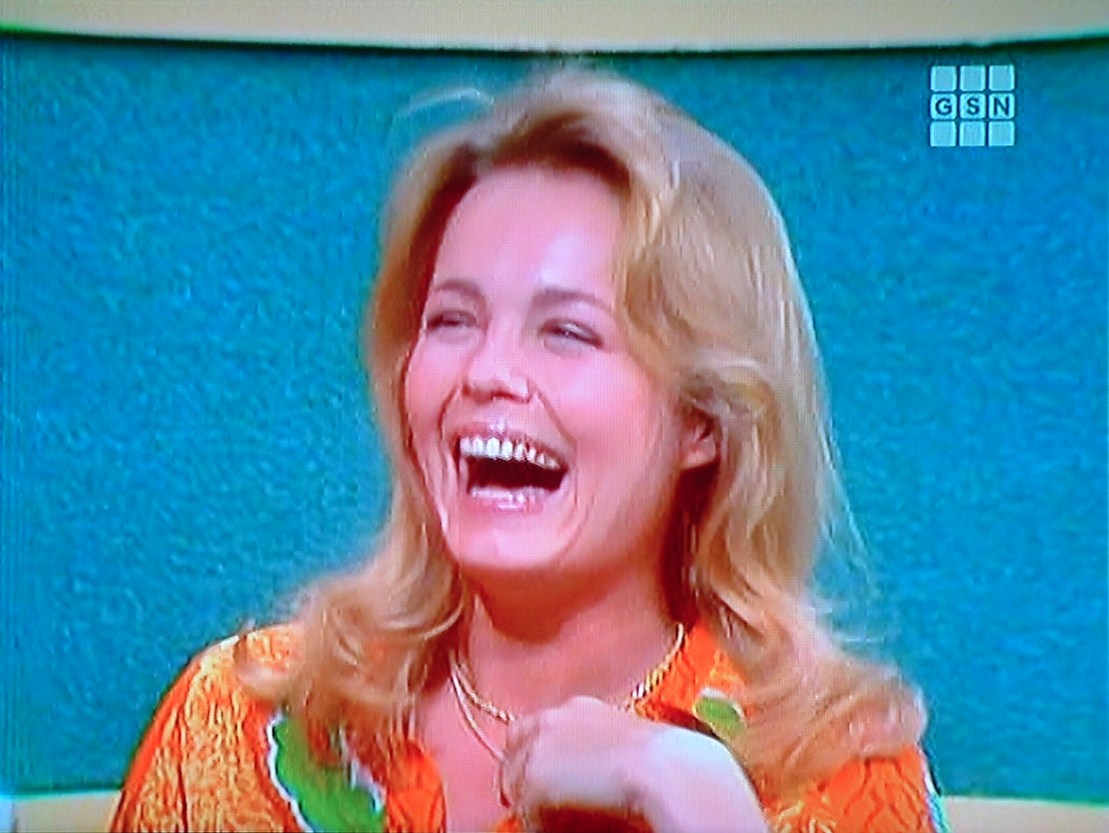
Get Ready to Forget the "Match Game" Star! #1: Trish Stewart

FOR you who re-member watching those celebrity-loaded TV game shows of the '70s-'80s, how the producers of these programs de-fined "celebrity" ran contrary to your definition. These shows could only get people of the "B" list, "also-ran", "washed up", "up and coming" or "flash in the pan" variety.

Add to that list the category of actors most alien to little kids: somebody from a soap opera! They were what only your mother watched (or taped to watch later when VCRs became common-place); they were what sent a kid outside to play until the cartoons came on later in the day, if school wasn't an issue.

Imagine what my response was when I decided to try out my DVR by recording some episodes of the kitsch classic Match Game '75, and I saw... her. My first reaction was, "Wow! Something even better than Charles Nelson Reilly's wisecracks!" This lady's lovely by today's standards; these pictures don't lie.

She is Trish Stewart, and at the time, she was one of the original cast members of the CBS soap The Young and the Restless (1973-present). I recall my mother watching this when it premiered (or not long after) due to the main title "Nadia's Theme", which later became a hit in '76 (#8 on Billboard).

I remember first hearing the music used as an underscore cue in Stanley Kramer's '71 movie Bless the Beasts and Children, which re-ran on TV quite a few times prior to the debut of TYatR. (The Barry De Vorzon and Perry Botkin, Jr. com-position was initially called "Cotton's Theme".)

This would later be retitled "Nadia's Theme" when ABC (the network airing the '76 summer Olympics in Montreal) lent the music to Romanian gymnast Nadia Comaneci for use in competition. She never used it for a routine, but she still won gold medals. The instrumental went on to win a Grammy in '77.

Back to Trish; if you click on her IMDb link, you'll see the other TV programs she appeared on during her time in the spotlight. I don't remember seeing her in some of these shows, but in light of her Match Game appearance (one of many she did), I sure wouldn't mind seeing more of her, she left such an impression.

Easily, she's the most natural and least pretentious of the six panelists on in the week's run of shows (five) I saw, more pleasant than regulars Brett Somers, Richard Dawson, Gary Burghoff or host Gene Rayburn, who tended to get on my nerves if I watched MG too much. (CNR was not on that week.)

She reminded me of the younger Candice Bergen who had appeared on the first season of Saturday Night Live ('75) by how she dressed sharply (by '70s standards), her shoulder-length hair (though Bergen's a brunette) and how the men on the show noticably treated her like a lady.

As I take the time to think of popular stars who started on soap operas and went on to bigger and better things, I then think about the vivacious woman I saw on MG and wonder what was wrong with her that she couldn't move beyond TYatR (which she left in '84). Was it because of her being on MG? Of course not.

There's a difference between good actors and big stars. Good actors are "a dime a dozen", and big stars are "one in a million". Sometimes, it's hard to believe some performer who appears to come off like a million bucks is actually worth ten cents to the entertainment industry. In that sense, Trish is, herself, "one in a million" amongst dozens of people. In the final analysis, as long as reruns of her shows play on TV (or DVD), she won't be truly be forgotten...compared to an Avery Schreiber.

I think I'll hold on to these DVR recordings for a while.

Keeping it trivial....

Fang Shih-yu, Shaolin Temple.

Friday, October 1, 2010

Men From the Monastery (1974), starring Fu Sheng, Chi Kuan-chi and Chen Kuan-tai. Directed by Chang Cheh.

DIRECTOR Chang Cheh must have had some regrets about making Men From the Monastery; why else would he rework such substantial pieces of it into The Shaolin Avengers and Shaolin Temple (both 1976)?

Of all Cheh's eight films in his "Shaolin cycle", MFtM is the one most devalued, if most of all of the written critiques I've read about it is any indication. I feel this may be an excessive judgement. If this can be considered a lesser Cheh effort, it's one that's more entertaining than the flawed attempts at experimentation like The Fantastic Magic Baby (1975) or Heaven and Hell (1978). It also includes the full-fledged debut of a Shaw favorite; more on him in a little bit.


The story is divided into four chapters, the first one featuring Fang Shih-yu (Fu Sheng). Fang attempts to leave the Shaolin Temple, and after clearing the wooden men alley, one of the two brothers on guard, Chen Si Di (Tung Choi Bo), tries to stab Fang before he departs. The other brother on duty takes the knife for Fang, allowing him to escape. Chen tells fellow Qing loyalist Feng Dao De (Lo Dik) of his failure to stop him, and they both go to Zhi Shan, the abbot, to try pinning the murder on Fang. The abbot doesn't believe them for a minute, so on advice from their fellow Shaolin traitor, Brother White Brow, they decide to return to the Wu Dang Martial Arts School and deal with Fang later, White Brow plotting to take care of the abbot another day.

Fang goes to a nearby town to look up an old friend, He Da Yong; from him, Fang learns his old Qing nemesis, Lei Lao Hu, has been practicing pile formation (pole) fighting while he was away at the temple; he's killed two people already. Fang's pal offers to help him with the basics of the formation, but he's murdered by Lei's men the next day as he chops down a tree for a pole. Fang retaliates; he slays Lei's men and quickly hunts down Lei himself, who's waiting for him atop his own pole formation (with sharp bamboo spikes along the ground below, ready for those unfortunate to fall and be impaled on them). Despite a lack of experience on the poles, Fang triumphs over Lei with what he learned from Shaolin.


The second chapter spotlights Hu Hui-chien (Chi Kuan-chi). In Guangzhou, two outlaw Qing symphathizers (instructors from the Jing Lung Martial Arts School) kill Hu's father (Wu Chih-ching), and he wants revenge. His determination is better than his martial arts skills, and he endures their repeated trouncings, even a near drowning where he gets rescued by his girlfriend, Li Cui Ping. Fang intervenes during another ill-advised fight, and he suggests to Hu some time at the Shaolin Temple will help him to defeat them.

Three years later, Hu leaves the temple, and with minor assistance from Fang, he turns the tables on his tormentors, wrecking the Jing Lung school and beating up the troublesome instructors. In a final move to make an example out of the two, he brings them back to the school in front of the students still around, stating these murdering thugs are from the Wu Dang school and are allied with Feng Dao De. The school can still operate, but if they ever cause trouble like their instructors, he'll beat them up, too. As the two suddenly jump up for another attack, he swiftly kills them, their death bringing home to all who witness it the earnestness of Hu's message.


The third chapter focuses on Hung Tsi-kwan (Chen Kuan-tai). After Hung manages to slip out of a brothel before a band of Qing soldiers led by Lei Da Pang (Wang Ching) can catch him, he goes off to convene a meeting of Shaolin disciples where he tells all in attendance that they must look for more men who oppose the Qing.

Prior to the meeting, he met up with two disciples on the road (one of them played by Bruce Tong), who were soon discovered to have been tailed by Lei and his men. Hung and the small group of Shaolin men got every Qing but Lei, who fled the scene when the going got tough.

Presently, Lei reports what occurred to his superior, Gao Jin Zhong (Kong Do). Angered, Gao gives the order to burn down the Shaolin Temple and to begin hunting down and exterminating the fugitives.


The final chapter (titled Men From the Monastery) wraps things all up. After the temple is burned down, and the abbot is killed by White Brow, the assembled Shaolin disciples split up to keep ahead of the Qing. An attempt to hole up on a Chinese Opera troupe's boat is foiled by Lei and his men. Li escapes, and two of the Qing, posing as rebels, go with her to find Hung and the others, one of the men leaving trail markers for the other Qing to follow. Li is on to their ruse; she leads them to the Shaolin men, but they are killed before they have a chance to report back to Gao and Lei.

The Qing lose track of the disciples until Chen Si Di spies two of them transporting sacks of rice to an abandoned temple where Hung and the others are hiding out. Upon hearing this news, Gao and Lei mobilize their men and go to eradicate the Shaolin rebels. As for Feng Dao De, he's along to take out only one of them: Fang Shih-yu....

After that...NO "SPOILERS"!


I have no trouble with the general story as structured by Cheh and writer Ni Kuang; the plot is slightly overrun by the action, but not to extremes. The lack of characterization doesn't hurt here because the pace is fast enough you never get the chance to dwell on it. For continuity buffs, however, the thread of familiarity connecting MFtM to Heroes Two will drive some nuts. Cast members, standing sets and outdoor locations used in HT that show up here again are not always redressed well, though some of the returning actors actually get (arguably) better parts in this! For anyone used to the conventions of low-budgeted movies, all of this just adds to the enjoyment factor, including good photography and well-selected music cues.

The main sticking point to many is the contribution Lau Kar Leung (with Tong Gaai) brings to the fight choreography. While it's not lacking in action, it is missing a lot of the moves of the "Hung Fist" style. What got spotlighted in HT got over-looked here. It's an apparent oversight (caught after the fact) that did not happen again in the other sequels. Even so, "heroic bloodshed" is in abundance and doesn't disappoint; cuts to black & white film and red tints are part of the film's bloody climax.

While Chen Kuan-tai returns as Hung, his prescence in the story is reduced (the bulk of it carried by Fu Sheng and Chi Kuan-chi), which disappointed me some, but he does have his moments here. (Executioners from Shaolin would let him encore Hung a final time in a more memorable way.) Fu Sheng continues to shine as Fang, and his pole-fighting sequence is a well-edited highlight; there's more tension felt with the close and low shots than what the re-staging had in The Shaolin Avengers. Chi Kuan-chi manages to make a good impression in his first big part as Hu, even if it's somewhat laughable (and implausible) to see this muscular fighting machine get his butt handed to him earlier in his segment! Once he's in the temple, he becomes that more familiar, upstoppable "force of nature" with dazzling moves. He doesn't get to show much dramatic range here, but he plays his part capably.

The rest of the supporting cast are comparably good. Among the heavies, even though Kong Do's role is of the highest-ranking Qing, no one actor dominates overall. All of them have limited screen time, so the villainy is rather diluted; Lo Dik as Feng caught my attention out of all of them. I wish I knew the names of the ladies who played Li (Hu's girlfriend) and Hung Ying (the woman Hung was with at the brothel); they both had plum parts here where they weren't submissive victims. (If anyone does know who they are, drop a note here in a comment!)

The rudimentary nice assemblage of the IVL DVD is given a boost in the "extras" department with the original trailer included. The main presentation has a very good anamorphic picture and clear, strong mono audio (Mandarin language); unless Tokyo Shock considers making it a future release, this is as good as the movie's gonna get.

MFtM is not a bad film; it just presses the limits of its modest budget and limited production schedule by cramming so much into an hour and a half. That this "rush job" would spur Cheh on to revisit the material (by spreading it out over two movies) makes sense. Still, MFtM succeeds through the majority of its parts (if not as a whole), and there's a mess of them, so that's the cinematic equilvalent of a high batting average. To take the baseball analogy further, it's not so much a "grand slam" as it is a hit that gets you to third base, and that's not bad at all!

More for fans of Fu Sheng and Chi Kuan-chi than for you Chen Kuan-tai lovers! Otherwise, complete your "Shaolin cycle" collection with this! Recommended by Brother Fang!

Keeping it trivial....

Fang Shih-yu, Shaolin Temple.

P.S. - Purchase it from Play-Asia by clicking on here.

Tuesday, September 21, 2010

Linus vs. the Red Baron?

REVISITING the same Peanuts comic book mentioned in a previous posting, here's another page from that issue. See anything familiar here?

(Click on image for better look.)
Since the comic is missing four pages, this is clearly the second page to a story where Linus, after having seen a magazine with a picture of a man on a flying carpet right out of One Thousand and One Nights (a.k.a. Arabian Nights), tries to ride his security blanket like one.

Figure it out yet?

Yes, Linus Van Pelt is wearing an aviator's helmet with goggles, and it looks a lot like the one Snoopy wore commencing with the first "Red Baron" episode of the Peanuts comic strip dated Sunday, October 10, 1965. The comic book was published about seven years prior! (Remember, that's back in 1958.)


Looking again at the biography Schulz and Peanuts by David Michaelis, it relates the origin of Charles Schulz's inspiration for the "RB" strips as coming from his son, Monty. Sometime during the summer of '65, the 13 year-old boy came into his father's drawing studio with a model of a Fokker triplane; as they talked about it, Schulz thought back to old WWI war movies (like Hell's Angels), and he decided to parody them. For years, Monte claimed it was his suggestion Snoopy would be the pilot of the "Sopwith Camel" (a.k.a. the doghouse); Schulz would consistently dismiss this notion until near the end of his life when he finally acknowledged his son's contribution.

Snoopy's debut as the World War I Flying Ace.
Schulz's assistant during '58, Jim Sasseville, worked on the comic books, and there's a chance he drew Linus with this headgear. If Sasseville spent enough time with Schulz on any given week, they were bound to have talked about many things; could some of their topics have included WWI movies and/or the Red Baron?

Or was Sasseville (or whoever) thinking of aviation pioneer Charles Lindbergh? It was only a year prior the movie biography The Spirit of St. Louis came out, starring Jimmy Stewart and directed by Billy Wilder. This makes more sense.

Scene from The Spirit of St. Louis (1957).

When I first got this comic back in the late '80s, I thought the possibility of a connection between this story to the later "RB" material highly bizarre to be believed; this was before I actually could find more to read about the history of the Peanuts comic book, my only reference for it at the time being the Overstreet Comic Book Price Guide. Luckily, when I randomly got a biography of Jimmy Stewart at the library years later, and I read what year TSoSL was released, I remembered my comic. With another look at it, I then realized where the reference point in the comic book likely came from.

Charles Schulz did not swipe an idea from his former employee in 1965; it's merely the most oddest of coincidences.

Speaking of odd, on the next page of the story, Linus notices the man in the picture is wearing a turban; maybe one of these will help him to fly, so....

Please don't show this image to a
Republican up for re-election!
Of course, he unwittingly uses his blanket, so when he wonders where his "magic carpet" escaped to, Lucy points at the top of his head! Another attempt at lift-off with a fan running at full speed doesn't work, either. Happily, the problem gets solved, thanks to the "American ingenuity" of Charlie Brown:


Keeping it trivial....

Fang Shih-yu, Shaolin Temple.

Sunday, September 19, 2010

The Young Avenger (1972), starring Shih Szu, Yueh Hua and Fan Mei Sheng. Directed by Yueh Fung.

HOWEVER long she's on the screen in a Shaw Brothers movie, I get a lot out of a performance from Shih Szu. Even though she was brought in as a replacement for Cheng Pei-pei, we know she ultimately turned out to be her own person. Her striking beauty was equally as impressive as her dramatic range and her physical capabilities with swords or martial arts. Only a injury that occurred while on the set in the mid-'70s would take her from action parts (she was "deemed a safety hazard", according to the Shaw Brothers Reloaded site) to the standard "leading lady/victim" ones. By 1980, she'd be gone from Shaw; it was their loss.

Let's revisit her earlier times with her role as the title character in The Young Avenger. It's a typical "Shih Szu: Phase One" film, and that's a good thing.

After an exciting fight (during the opening titles) introduces us to Bao Zhu (a.k.a. "The Young Avenger", a renowned hero/assassin in the martial arts world), we go back ten years to Wan Sang Town, where the hunch-backed Liu Tou (the "Judge"), one of the three outlaw brothers known as the "Heroes of Qin Town" (Fan Mei Sheng, The Kiss of Death), arrives looking for Li Kui ("The Old Chief"), one of four brothers known as the "Heroes of Jiangnan" (Tung Lin, King Boxer). Twenty years prior, Liu's brother was killed by Li (he says it was accidental) with his mighty Dragonsword, and he now wants Li to pass on to him how to use the sword as a way to make up for the death.

Li says It's been so many years since he's used his sword, he he can't even recall the technique, so he must decline the request to a simmering Liu. Hours later, Liu shows up at Li's house, finding the old man practicing with the Dragonsword; even so, Li claims (smooth as his moves are) he still doesn't know everything! A skirmish breaks out; Li's victorious, but Liu gets in an Iron Palm "sucker punch" before leaving, saying there'll be a rematch in ten years at the Mid-Autumn Festival.

Seconds after Liu's gone, it turns out the Iron Palm dealt a fatal wound to Li. On his deathbed, the sifu tells his student, Er Hu Zi (Ng Ming Tsui, The Blade Spares None) to take his young daughter, Bao, to her fourth uncle (known as "The Mad Monk", but these days, he's just a monk) at Dai Bei Temple to learn the Dragonsword technique so she may avenge his death.

Li's sister (Chen Yen Yen, Dead End), there to watch over him with her son, Chen Shi Lun, protests the idea, and considering how her boy would rather learn martial arts than study, it's easy to see why she feels this way. However, Bao wants to go, too, so the decision's final; she leaves the next day, cousin Chen giving her a small, porcelain Bhudda as a going-away gift before she's gone. When Li's third brother ("The Bookworm") arrives to mourn, he hears of Chen's learning issues and offers to help him out, including teaching him the Iron Fan Technique (with an actual iron fan that has deadly sharp tips).

Then, we return to the present day, where the now-adult, fully-trained Bao is walking the long journey back home. Despite being a paid assassin and ocassional bounty hunter, she leads a beggar's existence. After some battles along the way, she arrives back at Wan Sang Town. She goes to an inn to eat, but the workers do not want to serve this scruffy person, certainly not one who dares to sit at a table reserved for the inn's owner. When she flashes money, in addition to a tough attitude, they leave her be.

To her surprise, the owner is her grown-up cousin Chen (Yueh Hua, Come Drink with Me). She manages to catch his attention by throwing the little Bhudda she has saved for all those years at him; his reflexes are quick, and he catches it with his iron fan. He immediately knows who she is, and he knows why she's come back; after all, the Mid-Autumn Festival is only days away. After an emotional reunion with him and her aunt, she settles in her father's old residence and awaits Liu's return.

Ahead of his arrival, Liu has sent forces to surround the town. A spy (Liu's brother) is sent in to see if Bao is there. She sees him, and Chen quickly captures him. Along with Er Hu Zi, the two find out who he is and what's going on. Chen tries to let him go to give Liu's men the message that Bao is in town, but the vengeance-fueled lady slays him before he has a chance to leave.

Her actions aggravate an already bad situation; in retaliation, an innocent farmer is taken down with an arrow courtesy of Liu's men. Despite this, the citizens haven't forgotten how Bao's father helped them in the past, so they prepare for the advancing enemy, with Bao's fight now their fight, too.

So it goes that Liu's sneak attack on Wan Sang back fires, Chen and the townspeople taking out most of those men before Liu finally arrives. He's a little grayer, but still just as nasty; he's ready to take on the daughter of Li Kiu....

NO "SPOILERS" from here on!

Oh, that face! Shih Szu.

The most interesting observation to be made about TYA is regarding the nature of Bao Zhu. From the script by writers Ko Jui Fen and Hu Pao, we know she was sent off to learn how to use the Dragonsword in order to take revenge on Liu Tou, but at some point on her way back home, she decided to use her skills for reasons other than self defense. In the opening, she's been hired to kill the Tung brothers. Later on, she gets help from two inept robbers in liquidating men from a local triad a nearby town has a bounty on (so much money per member), letting her helpers keep the bulk of the reward. While the people we do see her eliminate are a rotten lot, there is an implication some of her victims didn't need to be killed, and she may have even gotten a little bloodthirsty at some point.

This may explain her emotional state when she's at the inn. Cousin Chen and the others have only heard so much about the scum she's taken out; her killings apparently went beyond those done in the name of "The Young Avenger", and she feels shame. Combined with the homecoming, thoughts of the impending fight with Liu, and all the blood spilt, she finally breaks down and cries. In the end, "The Young Avenger" is all too human. (Shih Szu's performance here, along with the music cues used, really caught me at this moment, giving me a slight lump in my throat. Her acting is the punctuation mark that gives her character the dimensions she has.)

Don't call Yueh Hua a "fan dancer"!

Beyond this variation in the almighty "REVENGE" theme, the script is fairly conventional. Director Yueh Fung (The Bells of Death) keeps things moving quickly and efficiently so other plot points never given any elaboration on are bypassed in order to get to the action. (Another thing to ponder: Are cousins Bao and Chen sweethearts?) If seconds or minutes have been trimmed from this, it's hard to tell where, so credit the unidentified film editor with doing a solid job.

The cinematography by Kwang Han Lu (One-Armed Swordsman, The Assassin) is impeccable; he helps set the proper mood for the picture whether in studio or outdoor locations. (He certainly catches Shih Szu's face in flattering ways; she's as lovely dirty as she is cleaned up!) The fight choreography by Hsu Er Niu is never dull; he makes Shih Szu and Yueh Hua look good with a sword and the iron fan, respectively, and uses wirework sparingly for certain jumps. A lot of the music cues were new to my ears; wherever these came from, they add a lot to the tone of the film.

The cast isn't a huge one, which helps to keep the story on the small scale it's meant to be. Fan Mei Sheng does well as the main heavy, though his abscence in-between the beginning and the end seems too long. Top-billed Yueh Hua is just playing a supporting role like he did many times for Cheng Pei-pei, but he gives his usual above-average performance. He also gets a cool weapon in the iron fan; too bad he didn't get to use it more. (It can be thrown like a boomerang, reminding me some of the "flying guillotines" found in other "old school" martial arts movies.) Along with Chen Yen Yen, Ng Ming Tsui, Tang Ti and other faces familiar to regular viewers of Shaw movies, the remainder of players lend capable support.

The whole of the film rests on Shih Szu's shoulders, and she handles it with the stamina of Atlas. She does her fight scenes with her own kind of grace and intensity; it's in those moments when she shows her vulnerable side that she stands out over the likes of Pei-pei, Lily Ho and even Li Ching. She's not dressed up here like in one of her later roles (such as The Deadly Breaking Sword), but her physical prescence is still commanding. Attractive as she is from the neck down, it's her expressive face that draws the most attention, especially those hypnotic eyes. She mesmerized me every moment she was around.

Flaws in the story aside, TYA is a compelling blend of action and drama with an ending most people won't see coming! (I still have mixed feelings about it. Anyone who has seen this already knows what I mean.) The unexpected level of subtext found in the character of Bao Zhu is most welcome, and it will bring you back for additional viewings.

As is to be expected, the IVL DVD is a nice presentation, from the anamorphic picture to the Mandarin soundtrack and adequate English subs. Great as this movie is, you won't care that it lacks real "special features"!

Simply put, with Shih Szu in a Shaw movie, you can't go wrong! Recommended by Brother Fang!

Keeping it trivial....

Fang Shih-yu, Shaolin Temple.

P.S. - Purchase it from Play-Asia by clicking on here.

Tuesday, September 14, 2010

Happiness is a glass jaw....


Snoopy punches Lucy
RECENTLY re-discovered in the humor archive of the Trivia Wing was this precious, precious image I think everyone who enjoys reading the Peanuts comic strip or watching the cartoons (or maybe only eating Zingers) will be ecstatic to see.

This one's a beauty! No digital manipulating was used to create this picture, and what you're looking at is an un-enhanced photo of said image.

Can you guess where it came from? (HINT: it's not from Mad magazine, a "Tijuana Bible" or The Onion.) Think about it....

Give up?

It's from the Peanuts comic book.

No, I didn't just "blow your mind"! Let me elaborate....

As the popularity of Peanuts gained momentum in the mid-1950's, Dell Publishing Company, makers of kid-friendly, "Comics Code"-approved comic books came calling to creator Charles Schulz and United Features Syndicate, his employer.

The majority of Dell's comics were licensed from properties as varied as Donald Duck, Little Lulu or The Lone Ranger; they also did an array of adaptations of movies and TV shows like Lassie, Leave It to Beaver or No Time for Sergeants (the movie with Andy Griffith). Now they wanted to take a try at Peanuts; an agreement was reached sometime after initial contact.

The first comic (dated 1953-54) was a "one-shot" containing reprints of the strip. A few other Dell comics series would also include reprints until Four Color Comics #878 (Feb '58 cover date), when what author David Michaelis (in his Schulz biography, Schulz and Peanuts) called "extended play" stories [with new stories and art] began. With Schulz's workload already burdened with doing two comic strips at the same time (the other being the short-lived It's Only a Game, a strip about sports that debuted in '57), the primary work would be handled by others, while he contributed new artwork for covers only.

The main person who wrote and drew stories for Dell was Jim Sasseville (born in 1927), a friend and colleague of Schulz's from the days when they both worked at Art Instruction, Inc. in Minneapolis. Sasseville had since become Schulz's assistant, and his main duty up until the Dell books came along was inking finished artwork and lettering for IOaG. Now, he'd be "ghosting" the comic books for $100 a week. After three Four Colors, the new material graduated to its own comic, the numbering starting at number 4 (Feb-March '60).

According to Michaelis, Sasseville was a very good artist in his
own right, and his greatest asset was a unique one; after Schulz, he was one of a select few who could draw Charlie Brown's round head. (It's not easy, as this amateur artist can testify!) Though the comic book which this picture came from is the first issue (May 1963) of the Gold Key run (Dell under a new name, actually), the material inside is copyright 1958, so it's reprints of a Dell book from '58. Based on the quality of some (not all) of the art (including some renderings of Charlie Brown's head), evidence suggests Sasseville's handiwork is in here.

He might have done "The Hero", which is where this picture came from. The actual story (like all the stories in the book) is too long and lacks Schulz's humorous touches and comedic timing; the priceless illustration is the absolute highlight of the entire mess, it's so masterfully executed. Considering the "violent" content of the drawing (arguably, a touch stronger than what sometimes happened in the strip), I thought Dell would've objected to it and have the panel changed. Then again, it's a beagle belting a "fussbudget", so there's no harm or foul!

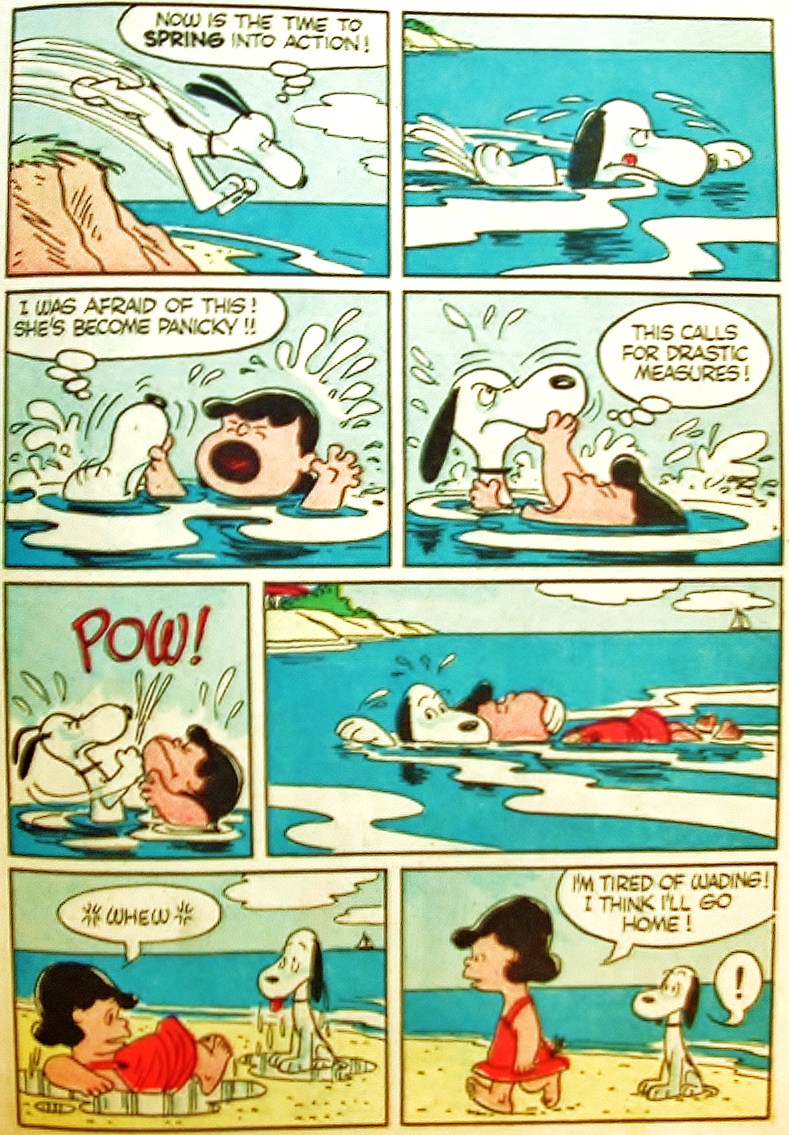
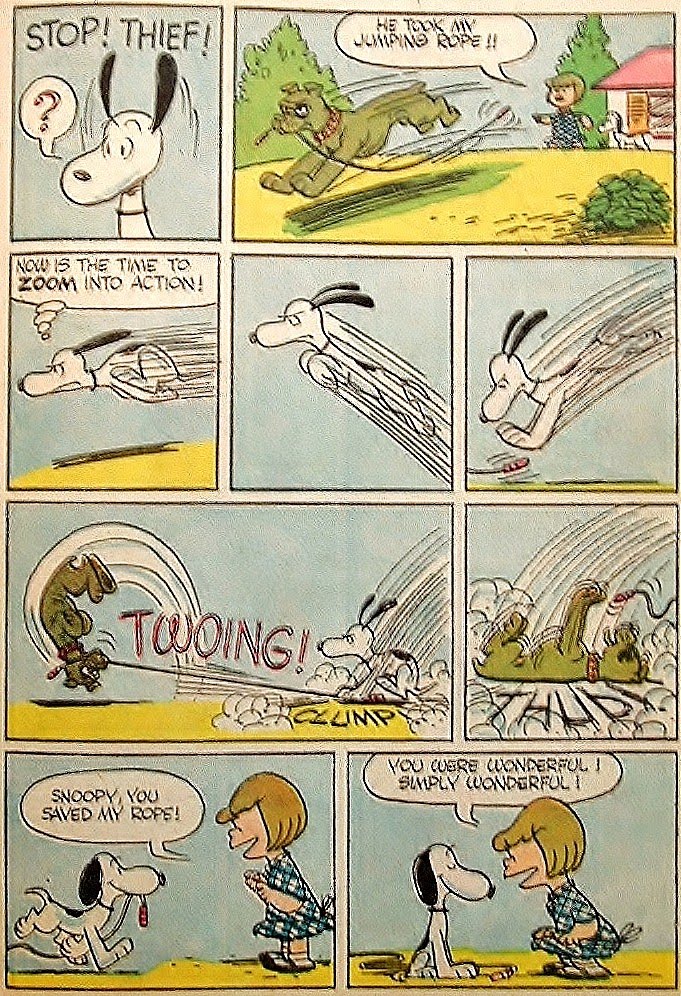
Check out the full story below! I decided on taking photos of the pages so their warped nature will simulate reading an actual well-worn comic! (NOTE: pages have been enhanced for an attempt at clarity; click on them for a better look.)

The last Dell was lucky number 13 (May-July '62). The last Gold Key was number 4 ( Feb '64), all of them reprints.

As for Jim Sasseville, Schulz eventually decided to devote all his energy to Peanuts, so he let Sasseville assume full control of IOaG; the strip ended a 63-week run in 1959. In 1960, he'd leave cartooning to be a graphic artist. He died on November 30, 2005, at the age of 78.


I think it's cool he got to work with Schulz in the capacity he did. (All written accounts I've read strongly maintain Charles Schulz never had help with the drawing and writing of the Peanuts comic strip, period!) Most of all, I'll always have a soft spot in my heart for the guy who drew what I consider the pen-and-ink equivalent of The Mona Lisa.

It's the best Peanuts drawing Schulz never did!

Keeping it trivial....

Fang Shih-yu, Shaolin Temple.