Powered By Blogger
Showing posts with label Lo Dik. Show all posts

Thursday, February 10, 2011

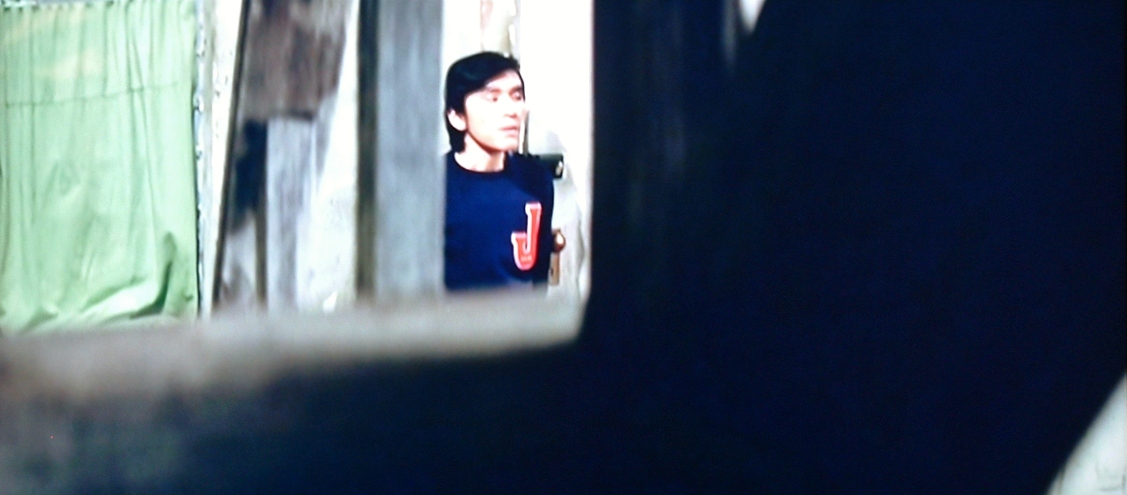
The Delinquent (1973), starring Wong Chung, Lo Dik and Lily Li. Directed by Chang Cheh and Kuei Cheh-hung.

(All images courtesy Celestial Pictures.)

IF Friends can be categorized as a fairy tale (a little Grimm, by some measure), then The Delinquent is pure tragedy. This could be said about more than a few of director Chang Cheh's better-known Shaw Brothers movies (like The Assassin or The Heroic Ones), but The Delinquent towers over them all with its unique, increasingly morose tone. Out of all Cheh's attempts to emulate the angst of the "Reckless Youth" found in Rebel Without a Cause (1955), he succeeds here --exceeds, really-- the best. (James Dean's "Jimmy Stark" in RWaC wouldn't last five minutes in this bleak Hong Kong.) However, he wouldn't have created this triumph without the help of three key people: writer Ni Kuang, co-director Kuei Cheh-hung and actor Wong Chung (in his first leading role).

As the plot generally goes, the teenaged John (Wong Chung) convinces himself the easiest, quickest way he and his father (Lo Dik) can get out of living and working in the HK slums is if he helps Boss Lam (Tung Lin) and his gang of robbers get into Wing Kee Warehouse to clean it out, after which John will be given a generous portion of the profits for his assistance. What complicates matters is his father is the head night-watchman at the warehouse.

While we don't know all of John's backstory, we can guess things started getting tough when his mother (seen in a brief flashback) left home. Apparently, she tired of being a housewife at some point and started going out evenings; his father thought slapping her around would bring her back to reality. It did; she divorced him and married an understanding butcher (Shum Lo). Her subsequent attempts to communicate with John through messages delivered to him by his girlfriend, Elaine (Lily Li), only serve to anger him.

The script rationalizes the father's boorishness to his being head of the household and his reputation around the area for being rough on would-be crooks who've previously tried to break into the warehouse. He wants John to get ahead in the world through hard work and avoiding shortcuts to prosperity. Though John loves his father, he sees the results of all the old man's laboring as a big waste, because it seems he hasn't advanced any further than those who also find time to relax and raise hell once in a while. These days, John is taking after more like his mother, so his father can't help but worry.

Sometime after he's fired from his job at a restaurant for fighting on the streets too much (which always brought the cops to the establishment, to the detriment of their business), John gets word of how Boss Lam needs him so they can infiltrate the warehouse. Lam's underling, Big Sean (Fan Mei Sheng), oversees a brothel, and he offers a woman to John as a means to win him over. Even after a night with her, John can't commit to the deal; when Big Sean then demands immediate payment for sleeping with the lady, John only offers to pay him later. In short order, Big Sean and some of Lam's other men track him down at a beach and beat him up when he decides not to pay at all.

Shortly, John is picked up by the police, and when his father refuses to post bail for him this time, it's Boss Lam who sets him free. Lam now talks directly with John about the proposition, offering him (in addition to money) employment, new clothes, a sports car and time with his girlfriend, Fanny (Pei Ti). It appears Lam doesn't want to mess with John's dad when he suggests to John if he can make his father take time off from work, nothing would happen to him once the caper goes down. John finally agrees to the scheme, and after a reconciliation with him, he persuades his father to take a two-day vacation.

Come the night of the robbery, when John finds out his father is filling in for the now-sick substitute, he quickly finds Lam and his men at a sawmill, telling them to postpone the operation. Of course, he finds out all too soon the deal's off; he's beaten up (again) and is left to have a deadly encounter with a buzzsaw. While John is occupied with escaping from his predicament, Lam and his men rob the warehouse, and in spite of his heroic efforts to stop them, John's father is killed. Upon finding out what all has transpired, John rapidly becomes a revenge-fueled killing machine, taking down Lam's associates one by one before finally confronting Lam himself.


With The Delinquent (released in the US as Street Gangs of Hong Kong), Kuang soloed on the script, writing a sad character study with a strong dose of violence that is always to be expected from a Cheh movie. (Had he done this as a collaboration with Cheh, I'm certain the emphasis would've been more on action.) Limited characterization behind the three lead parts hampers our empathizing with them, to a degree; John is adequately defined, his father has hints of complexity, but Elaine serves no real purpose beyond being rescued by John a couple of times or being an intermediary for him and his mom. (Lily Li gives a good performance, anyway.) Going past these minor problems, Kuang has crafted a cautionary tale where the moral is delivered like a sledgehammer between the eyes.

The original HK trailer for TD (included on the IVL DVD) promised audiences a "NEW KIND OF PRODUCTION" about "THE WRATH OF YOUTH EXPLODING LIKE A VOLCANO" that "WILL MOVIE (sic) YOU......AND EXCITE YOU!" and co-directors Cheh and Cheh-hung gave the people what they wanted. As for their joint effort on TD, it's commonly assumed the directing duties were divided, with Cheh-hung overseeing the dramatic, documentary-like scenes and Cheh handling the ones heavy on action (and his trademark "zoom" shots, though they're actually well-placed here). However, if we know anything of their filmographies, we see both were capable of versatility; based on this, it's more likely Cheh did most of the latter while Cheh-hung did most of the former. It's also possible Cheh saw something particular in Cheh-hung's own films that made him the choice for co-directing TD, because if Cheh had the likes of Wu Ma or Pao Hsueh-li on duty for this, we would not have had the level of emotional drama the movie has. Further, I think the two fed off the creative energies of each other, which is why their styles combine favorably in the completed picture, and TD ranks up there with their most analyzed films.

One of the "regulars" in Cheh movies of the late '60s through the early '70s, Wong Chung practically stepped out of obscurity to his first starring part. Whether TD was written for him or not, and considering all he's given to do during the feature (he's onscreen most of the time), it's gratifying to see the confidence the filmmakers had in letting Chung carry the bulk of the movie. He excels as John, portraying a likeable teenager with a chip on his shoulder who wants the world, and he wants it now. He makes a habit of following the impulses of youth without considering the consequences, from fighting anybody who teases him to jumping at the chance to have sex with a woman (when his girlfriend is saving herself until marriage). Only when he lets himself get involved with Boss Lam, he gets in over his head, with his father caught in the middle. He redeems himself by avenging his father's death in a burst of (volcanic) fury.


It is that very violence (along with the sexual content) which earned TD its (HK) Category "2B" rating (an "R" in the US). All of the film's fight choreography by Lau Kar Leung and Tong Gaai is above average, but it's the 12-minute finale that always gets discussed. The nonstop barrage of brutality and death as distributed by John, culminating in one of the most darkest endings in any Shaw production, is stunning to behold. (It still chills me to the bone after multiple views.) This climax alone should've made Chung another big Shaw star, but he would eventually be overshadowed (in director Cheh's eyes) by his next co-star, Fu Sheng (in Police Force), leaving him to nearly fade into the background before he took up directing his own movies. (What his career would've been like if Fu Sheng never arrived on the scene, I can't guess.)

Seen today, The Delinquent isn't as slick as today's HK flicks, but it still works, though anyone who craves action over melodrama may squirm during the downbeat material as they wait for the next fight scene. With a look of impressive authenticity due to extensive location filming, the film's depiction of a life in the slums, where the people settle for just "getting ahead", says much about their living situation; not once are words like "college" or "job training" ever brought up in the entire 101 minutes. If John didn't know he had other options, or if he did, and he never found the incentive to break away from the cycle of poverty, then that's the greatest tragedy of all.

Brother Fang says..."A worthwhile buy for fans of Chang Cheh, the underrated Kuei Cheh-hung and the criminally-ignored Wong Chung! For the uncertain, try it out by borrowing or renting! Remember, with the volume of mature content in this, do NOT play it with children or overly sensitive people around!"

Keeping it trivial....

Fang Shih-yu, Shaolin Temple.

P.S. - While you still can, purchase it from PlayAsia by clicking here.

Tuesday, January 18, 2011

Friends (1974), starring David Chiang, Fu Sheng, Lily Li and Frankie Wei. Directed by Chang Cheh.

(All images courtesy Celestial Pictures.)

IF you combine Rebel Without a Cause with The Bowery Boys, add a dash of Poor Little Rich Girl (in this story, a rich young man), and filter it through director Chang Cheh's "yang gang", the result wiil be Friends. It's the last Shaw Brothers movie Cheh would make in the "younger generation"-oriented vein, as his main focus shifted to the making of the "Shaolin" pictures. Though it was one of those very films (Heroes Two) that introduced HK moviegoers to new star Fu Sheng in early 1974, Friends was actually the first one (with him in a lead role) completed. Its release would be held up until the summer, and while it's only a good guess it did OK box office, what can be confirmed is the "Best Young Newcomer Award" the movie won at the '74 Asian Film Festival. The recipient: Fu Sheng.

After a prologue where we find the title characters have gathered for a reunion, their backstory (the rest of the film) is related as a flashback. Going back to ten years ago, there are just the nine of them (give or take), a bunch of twenty-somethings living a lower-class existence of doing menial jobs by day and raising hell at night; all of them desire to advance their standing in the world and live a better life. The bond of friendship manages to see them through bad times and good. The guys are also fortunate to find the spare time they can to keep their kung fu skills up to snuff, because they're necessary in a big city like HK.

Their unofficial leader is Hua Heng (David Chiang), an advertising sign painter who aspires to become a famous artist. His girlfriend is Gao Xin (Lily Li), a bargirl who might get forced into prostitution by the loan sharks she owes money to if she doesn't pay off her debt of $20,000 [HK].

Into their lives arrives Tu Jiaji (Fu Sheng), the only child of the wealthy Tu Dongtai (Lo Dik). Practicing martial arts only does so much for him; he's unhappy and bored living a sheltered life. One day, when he jumps in to help Heng fight off some street thugs, he's excited to meet someone closer to his age who's cool and can take care of himself. In turn, Jiaji (like a neglected puppy craving attention) trails after Heng to an abandoned warehouse, inadvertently introducing himself to Heng's other friends when he crashes through a sky window above their makeshift gymnasium in the basement.

It doesn't take long for Heng and the others to warm up to Jiaji; they think he's down on his luck like they are. Indeed, when he innocently asks why don't they work out at a "better gym," they think he's kidding around, and they nickname him "Young Master". With this new name, he doesn't bother bringing up his real one. He's also in no rush to go home, so he calls his dad, saying he's spending a few days with some "future" capitalists and not to worry. Concerned as Dontai is, he convinces himself Jiaji's all right and leaves him be.

Once Jiaji hears of Xin's money problems, he's resolved to get her out of trouble with help from another of his new friends, Lin Sibao (Lee Yung-git). While Jiaji pretends to sell some of Heng's paintings, he actually has Sibao get the money from his father (being sure not to mention he is Dongtai's son), using a ring of his (personally given to him by his father) as a means to getting the cash without a hassle. Of course, the instant Dongtai recognizes the ring, combined with the asking for money, he thinks Jiaji's been kidnapped, and he readily gives Sibao the full amount. For all the madness behind Jiaji's method (also driving his father mad), Xin's dilemna is resolved, and Heng comes off like a hero in the process.

Unfortunately, the recently unemployed Sibao is hurting for money, and in an act of weakness, he uses the ring again to extort more money from Dongtai. Worse, he's an acquaintance of the loan sharks, and when he flashes his new wealth in front of them, they can't help but wonder how he got rich all of a sudden. When Sibao tells them, showing them the ring, they realize the "Young Master" is the son of Dongtai, thanks to a newspaper ad he put out in hopes of communicating with the (then non-existent) kidnappers. Under orders from their boss (Frankie Wei), they kidnap Jiaji for real... with assistance from Sibao!

Once Sibao finds out Jiaji will be killed upon the collecting of the ransom (a triple dip into Dongtai's wallet), he finally sees the error of his ways, and he runs off to tell Heng what has occurred. Heng has since found out what Jiaji did for Xin, so once Sibao fills him in on the details of who Jiaji is and his current plight, he makes a frantic dash to rescue Jiaji from his captors, while Xin and Sibao round up the remaining friends for extra support in a race against time.


The most common complaint about Friends centers on how David Chiang and Fu Sheng interact as the leads. Some sense a lack of dynamics between them, which doesn't ring true with the assertion they are supposed to be friends. People forget that Jiaji and Heng get introduced to each other under tense circumstances, and Jiaji doesn't help matters when he ruins Heng's portrait of Xin by smashing it over his chauffeur's head! Further, Heng's trying to break out as an artist while juggling a girlfriend and a job at the same time. For all the friends he has now, the sudden surfacing of Jiaji (who appears to have no friends at the beginning of the film, except his sifu Wang, played by Tung Choi-bo) seems to be one friend too many for him to handle. Once Jiaji gets to meet Heng's other friends, any burden is lifted off his shoulders and distributed to everyone else; only then does he begin to see Jiaji's a nice guy. Significantly, what we are observing is the beginnning of a friendship over the few days' time covered in the film, and by having seen the prologue, we know it will still be thriving ten years later (and counting). As the start of friendships go, Chiang's performance rings true, and it compliments the one delivered by Sheng.

Allowing for the usual Shaw script deficien-cies, the screenplay by Cheh and Ni Kuang is pretty good, but more character development would've been beneficial to the story. (Among the precious few pearls we're given, Bruce Tong's vignette where he dreamily ogles women while working at a pool hall is very funny.) As this is a Cheh movie, we're lucky to have what characterization there is, and while there's more violence here than in Young People, also like that film, nobody dies, so we should appreciate any restraint Cheh decided to use. Even so, our "suspension of disbelief" is tested by how Jiaji gets the money to pay off the loan sharks and what leads to his being abducted. Most importantly, if this happened in the real world, Sibao would wind up in prison for being an accessory to kidnapping!

If you don't dig too deep into it, the movie works well within its low budget, from the photography by Miyaki Yukio (a.k.a. Kung Mu To) to the bone-crunching kung fu co-ordinated by action directors Lau Kar Leung and Tong Gaai. The casting works from the leading roles (though Lily Li is underused) to the supporting players. (As noted previously, the late Chen Wo-fu has a few moments here as Jin Bing-da, a mechanic; hindsight or not, his unique prescence is compelling enough you wish he had a bigger part.)


Out of all the pictures Cheh made, Friends qualifies as his top "sleeper". One look at it, and you'll understand why other Shaw fans pass this up in favor of his bloodiest classics. It's as close as he ever got to doing a "little" film, and at the same time, he conveys his recurring themes of brotherhood and "yang gang" in the most accessible way better than he ever did in his biggest epics. He takes his discovery Fu Sheng and gives him a modest showcase in which to display his bubbling talents. Sheng is up to this early challenge, bringing Jiaji to life as an engaging person. He's rough around the edges with respect to his acting and fighting skills, but any noticeable lapses are smoothed over with his winning personality and (especially for the ladies) sex appeal. Anybody who likes Chang Cheh, Fu Sheng or wanting a break from the "average" Shaw martial arts movie needs to buy (or rent) this.

Brother Fang says..."Fu Sheng fans: BUY this! Everyone else: Give it a test run (rent or borrow one) before investing in a copy!"

Keeping it trivial....

Fang Shih-yu, Shaolin Temple.

P.S. - Purchase it from DDDHouse by clicking here.